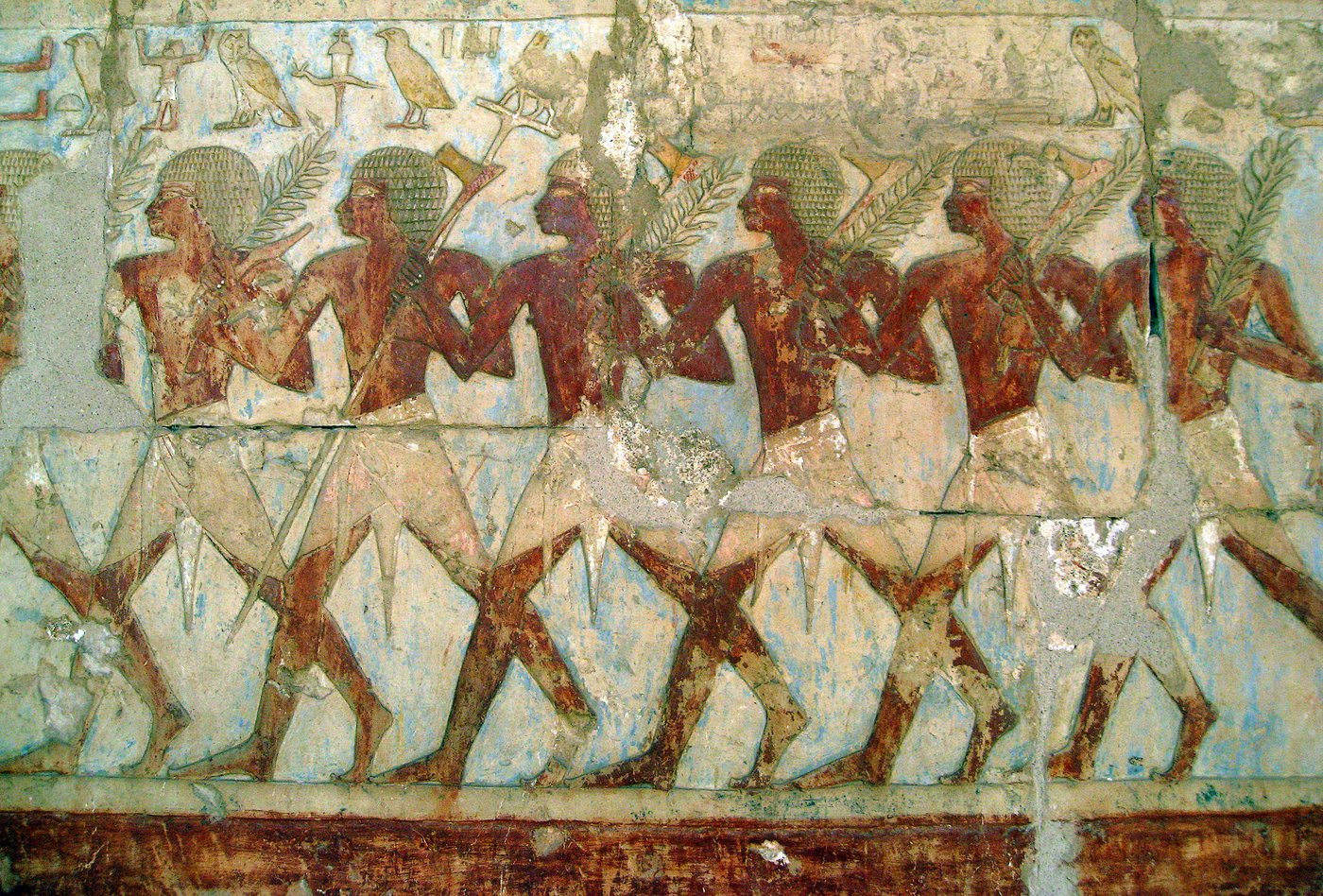
Around 1470 BCE, on a limestone terrace above the west bank at Thebes, sculptors were cutting a picture of a country that no map has held since. It was going on the wall of the queen's new temple at Deir el-Bahari, and it was oddly literal for Egyptian art. Round houses stood on stilts over the water, reached by ladders. Palms and squat incense trees grew between them. A local chief walked out to greet the Egyptian ships, and behind him came his wife, drawn with hips and thighs so heavy that scholars still argue over what the carver meant. The Egyptians called the place Ta-netjer, the God's Land. We call it Punt. For all the care in that wall, nobody today can put a pin in it.
Punt is one of the strangest gaps in ancient history. Egypt traded with it for more than a thousand years. Pharaohs boasted about the fleets they sent there and the marvels those fleets brought home. Scribes wrote its name in gold ink. And yet the place itself has never been found. There is no ruin we can label Punt, no Puntite city dug from the sand, not one line of writing that the Puntites left about themselves. Everything we know, we know because Egypt wrote it down. The country that sold Egypt its incense is visible only in the account books of its customer.
What the God's Land was worth
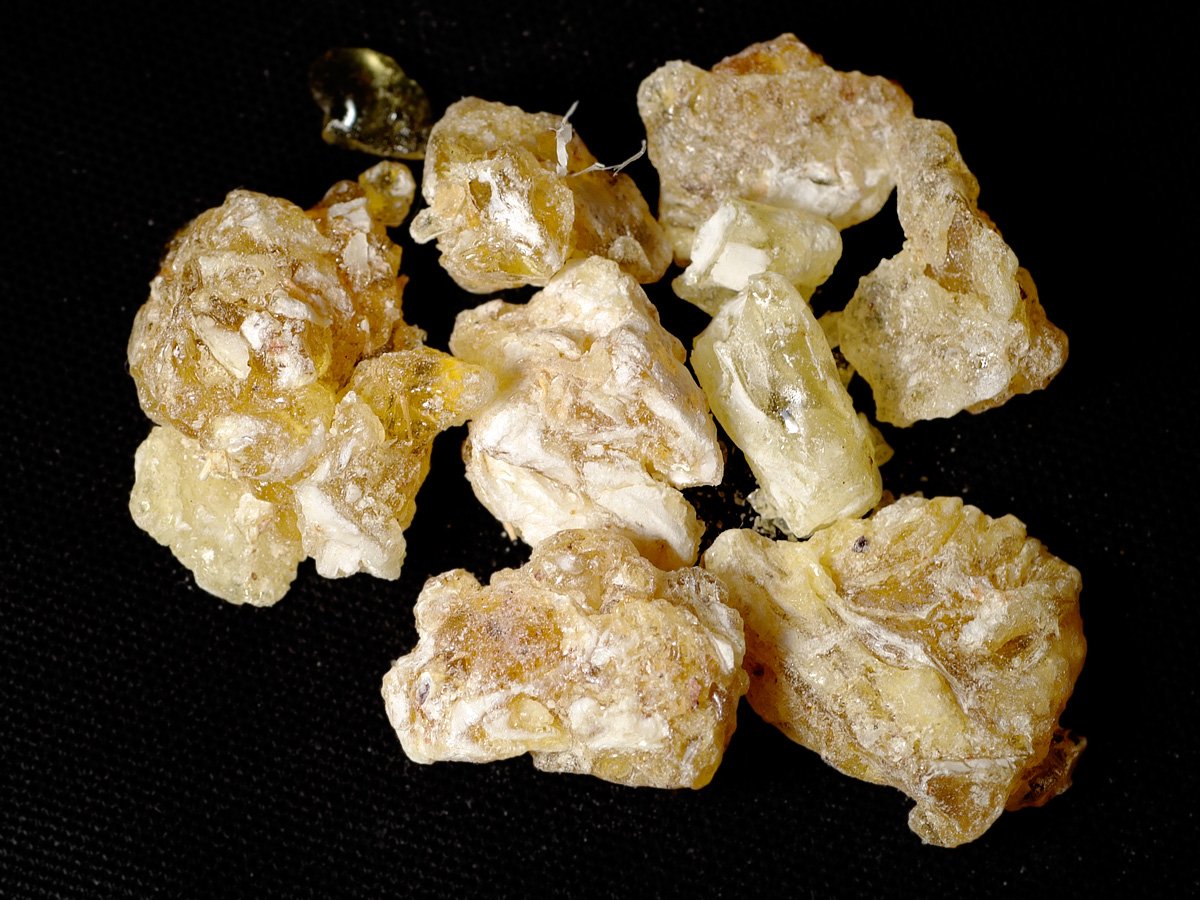
Start with why Egypt cared. Punt was where the good incense came from. Myrrh and frankincense, the aromatic gums that Egyptian religion burned by the ton, do not grow in the Nile valley. They come from dry country far to the south-east, from trees that bleed a resin when the bark is cut. Temple ritual ran on the stuff. So did embalming, medicine and perfume. A pharaoh who could not supply incense to the gods had a problem, and Punt was the fix.
The incense was only the headline. Egyptian lists of Punt goods read like the manifest of a luxury cargo: gold and electrum, ebony, ivory, leopard and panther skins, ostrich feathers and eggs, gum resins by the sackful, and live animals (greyhounds, cattle with strange horns, and baboons, which mattered more than they look). Hold on to the baboons. They come back at the end of this story, carrying an answer nobody expected them to hold.
Because the goods were rare and the journey was hard, Punt gathered a glow around it. Egyptian love poetry uses it as shorthand for anything sweet-smelling and far away. A Middle Kingdom tale, The Shipwrecked Sailor, strands its hero on a magical island ruled by a giant talking serpent whose body is sheathed in gold and whose breath is myrrh: an island of incense at the edge of the world, which reads a great deal like Punt turned into a fairy story. That glow is part of the trouble. The more wonderful Punt became on the page, the easier it was, later, to treat it as half-imaginary.
A trade older than the famous fleet
Hatshepsut's voyage is the one everybody knows, but she was joining a habit that was already ancient in her day. The first firm record goes back to Sahure, a pharaoh of the Fifth Dynasty around 2450 BCE, whose annals note myrrh, electrum and other treasures fetched from Punt. That is roughly the age of the last pyramids at Giza. By the time the queen's masons went to work, Egypt had been sending south for the God's Land for the better part of a thousand years.
The trips were expeditions, not tourism. Egypt had no permanent road or colony reaching Punt. Every voyage had to be mounted from scratch: crews raised, ships built or hauled in pieces across the desert, timed to the seasons, sent out, and, if all went well, brought back. The Middle Kingdom pharaohs did it. So did the New Kingdom ones. The last great state expedition on record went out under Ramesses III in the twelfth century BCE, and he listed the returns in careful detail, as if aware they were becoming rare.
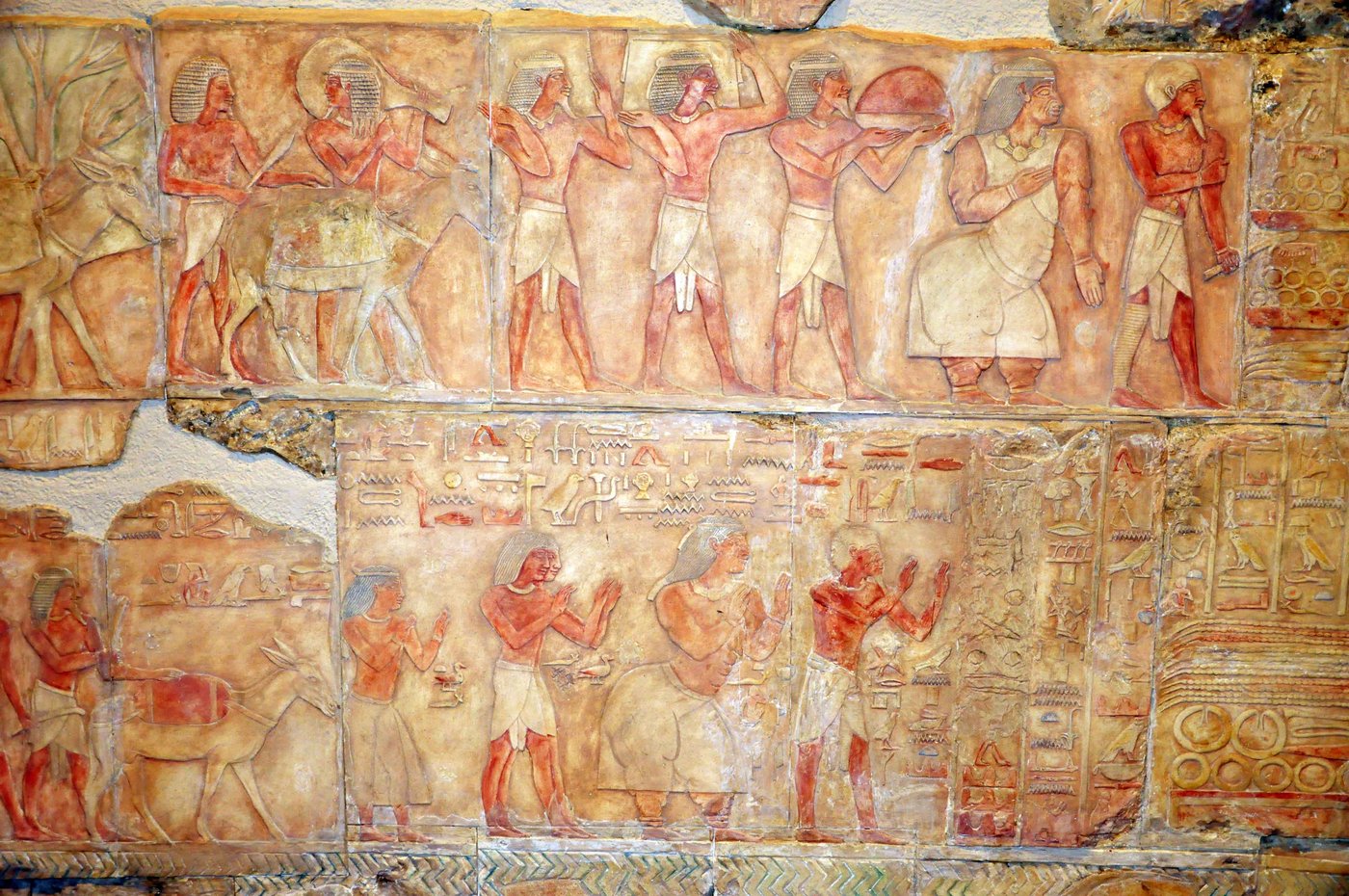
What makes Hatshepsut's version special is that she had it drawn in full. Her temple gives a running report of the whole trip. Five ships are loaded and rowed down the Red Sea. Punt appears with its houses and gardens. Its chief, a man named Parehu, comes out with his wife, drawn in that startling heavy-bodied way. Then the loading begins: myrrh piled in heaps, ebony and ivory, gold, apes, dogs, a live panther, and, the detail people remember, whole incense trees dug up with their root-balls packed in baskets, thirty-one of them, carried aboard to be replanted in Egypt. The planting pits for those trees were later found cut into the temple terrace. Egypt did not just buy incense from Punt. For one proud season, it tried to bring Punt home.
A place you could reach but not map
Here is the puzzle at the heart of it. The Egyptians clearly knew how to get to Punt. They went again and again over a thousand years. So why can we not follow them?
The answer is that they never wrote down the one thing we want. Egyptian records are proud, not practical. They tell you how many rings of gold came back and how pleased the god Amun was. They do not tell you the bearing, the number of days' sail, the landmarks along the coast. Directions were the private knowledge of expedition leaders, passed hand to hand and never meant for a temple wall. When the expeditions stopped, that knowledge died with the last men who held it. The destination did not vanish. The route to it did.
This is where myth and fact pull apart, and it is worth being plain about both. The myth, encouraged by centuries of romantic retelling, is that Punt was a shimmering never-never land, perhaps invented, perhaps impossibly far, a place Egypt dreamed rather than sailed to. The reality is duller and better: Punt was an ordinary foreign coast with goods Egypt wanted, reached by a hard but repeatable sea trip. A second myth is quieter but just as wrong: the old assumption that Egyptians were river people who could not really handle open water, so the whole Red Sea trade must be exaggerated. Two discoveries, one in the sand and one in a museum drawer, have knocked both ideas down.
The harbour built for a place no one can find
The first is a stretch of nothing much on the Red Sea coast, near the modern town of Safaga. Its ancient name was Saww. Today it is called Mersa Gawasis, and for a long time it looked like bare desert against the water. Between 2001 and 2011 two archaeologists, Kathryn Bard and Rodolfo Fattovich, dug into a low fossil-coral terrace there and found the working end of the Punt trade.
They found caves: galleries cut by hand into the rock and used as storerooms and ship sheds. Inside and around them lay the gear of seagoing expeditions from the Middle Kingdom, roughly four thousand years old and preserved by the dry salt air. There were cedar planks from dismantled ships, blades from great steering oars, and coils of rope still wound as a sailor had left them. There were limestone anchors. There were stone stelae recording royal missions to Punt and its neighbour, a district the texts call Bia-Punt.
Among the finds at Mersa Gawasis were two wooden cargo boxes, the kind used to pack a return shipment. Both still carried their ancient labels. The inscription reads, in the standard translation, "the wonderful things of Punt." It is a small thing and a large one at once. Here is a real container, from a real quay, packed for a real voyage, addressed to a place scholars keep being told might be a legend. Legends do not need shipping crates.
The timbers were solid enough that a naval archaeologist, Cheryl Ward, could reconstruct the kind of vessel they came from. A full-sized ship was built to the pattern and named Min of the Desert, and in 2009 it was sailed on the Red Sea to prove the design was seaworthy. It was. The Egyptians could and did cross open water. Mersa Gawasis is the launch pad, sitting exactly where a launch pad for a voyage of some 1,200 kilometres south ought to sit. It tells us where the ships left from. It does not, by itself, tell us where they landed.
The baboons that carried an address
The second discovery is stranger, and it turns on those baboons.
Egypt kept baboons, mummified them by the thousand, and linked them to Thoth, the god of writing and the moon. But no baboon is native to Egypt. Every one of them was imported alive, and one of the species involved, the sacred hamadryas baboon, lives in exactly the belt of country where Punt is supposed to lie. The animals were, in effect, luggage from the God's Land, and living things pick up a chemical fingerprint of wherever they grew up.
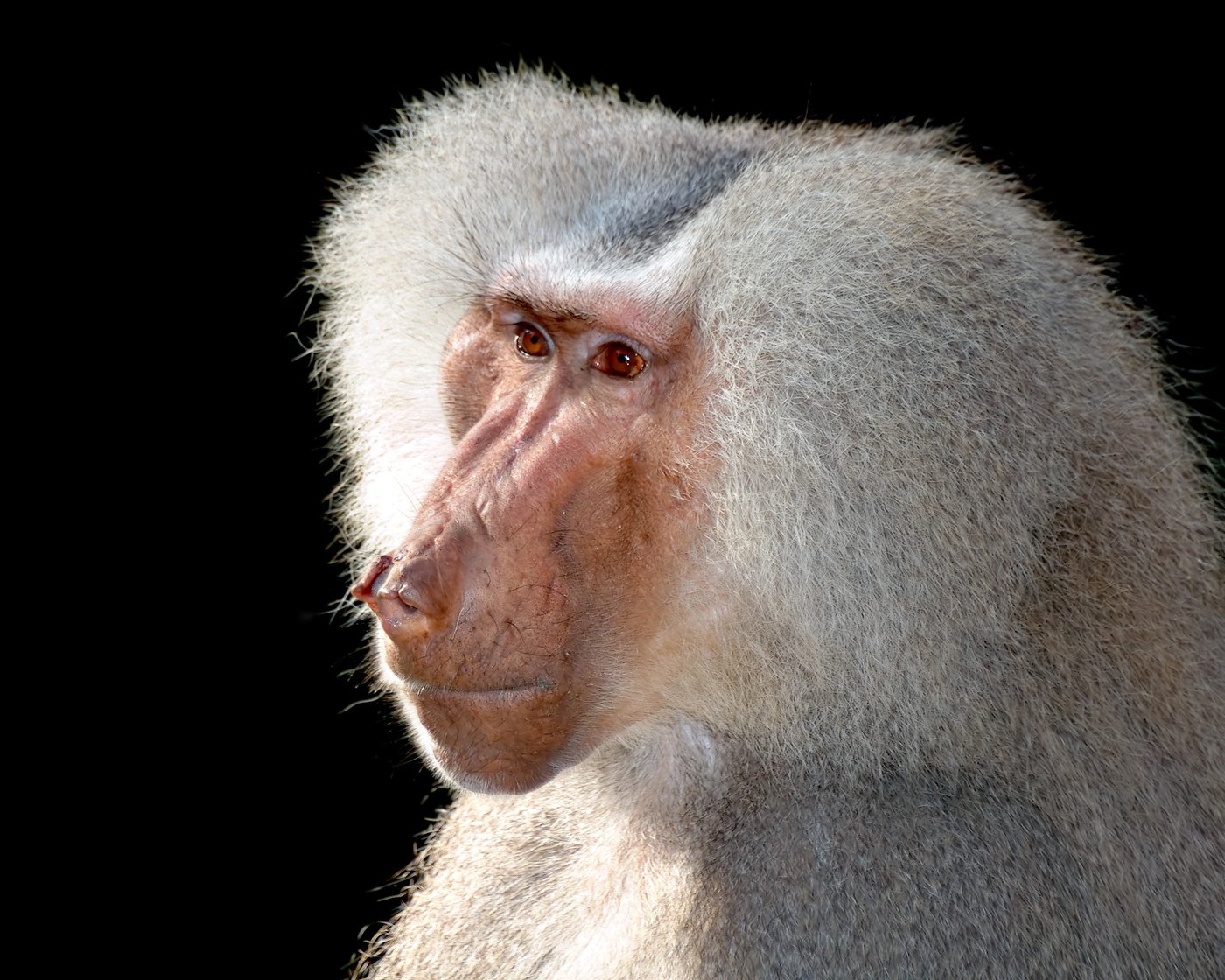
The fingerprint is in the ratio of strontium isotopes. Strontium comes up through the food chain from the bedrock, and different regions have different signatures, which get locked into teeth and bone as an animal grows. A team led by the primatologist Nathaniel Dominy measured that ratio in ancient Egyptian baboon mummies and compared it against baboons living across the Horn of Africa and southern Arabia today. The mummies were not homegrown. Their chemistry pointed away from Egypt and toward one region in particular.
Reported in the journal eLife in 2020, the strontium values from two New Kingdom baboon mummies best matched a zone taking in modern Eritrea, Ethiopia and Somalia: the eastern Horn of Africa. In other words, animals that Egyptians brought back as goods from the God's Land had grown up in that corridor. An imported monkey, dead for three thousand years, was carrying its home coordinates in its enamel the whole time. It just needed a spectrometer to be asked.
The baboons do not close the case on their own. But they do something the reliefs never could. The temple walls show what Punt sent; the isotopes show where at least one of those exports was born. Both arrows swing to the same stretch of the African coast.
Two coastlines, still competing
So where is it? The honest answer is a region, not a dot, and the debate is still live.
The strongest case puts Punt on the African side of the southern Red Sea and the Gulf of Aden: the coast and hinterland of what is now Eritrea, eastern Sudan, Djibouti, northern Ethiopia and Somalia. The incense trees grow there. The hamadryas baboons live there. The chemistry of the mummies points there. And at Mersa Gawasis the diggers turned up pottery and obsidian that came from that same African region, carried north on the returning ships. Many scholars now name Eritrea as the likeliest heart of it.
Not everyone agrees Punt was purely African. Some of the goods on Egypt's lists, certain resins above all, grow just as well across the water in southern Arabia, in what is now Yemen and Oman. A few texts can be read as pointing east rather than south. The tidiest solution may be that Punt was never a single kingdom with fixed borders but a trading zone straddling both shores of the strait, an African coast and its Arabian neighbour lumped under one Egyptian name. If so, we are hunting for something that was always more region than nation, which is exactly why the pin keeps slipping.
What almost no serious scholar now defends is the older habit of shoving Punt somewhere impossibly exotic, or of treating it as invented. The trend of the evidence has been steady and in one direction: toward a real, ordinary, reachable coast in the Horn of Africa, with a possible reach across the water. The mystery is shrinking. It has not closed.
The country that kept its own name
There is one loss here that no isotope will fix. Even if we settle the map tomorrow, we will still only know Punt as Egypt saw it: a supplier, a source of marvels, a wall of gifts flowing north. We have Egypt's word for the chief Parehu and his heavy-bodied wife. We do not have theirs. No Puntite scribe wrote down what the Egyptian ships looked like coming over the horizon, what the traders drove a hard bargain over, what the myrrh harvest cost the people who cut it. A whole society that dealt with a superpower for a thousand years left, so far as we can read it, not a single sentence in its own voice.
That is the odd shape of Punt. We can now point, roughly, at where it was. We can hold a crate that was packed there and name the animal that was born there. We can watch, on a temple wall, its chief step out to meet the ships. And still the God's Land stays on the far side of a strait we can cross in every way but one. Egypt sailed to Punt for a thousand years and brought back its trees, its gold and its monkeys. It never quite brought back Punt.
Read next: Berenike: The Roman Port That Buried Monkeys From India and Uluburun: The Bronze Age Wreck Whose Cargo Came From Three Continents.
Sources & further reading
- Nathaniel J. Dominy et al., "Mummified baboons reveal the far reach of early Egyptian mariners," eLife (2020) — the strontium-isotope study tracing New Kingdom baboon mummies to the Horn of Africa.
- Kathryn A. Bard and Rodolfo Fattovich, Seafaring Expeditions to Punt in the Middle Kingdom: Excavations at Mersa/Wadi Gawasis, Egypt (2018) — the harbour, the ship timbers and the "wonderful things of Punt" cargo boxes.
- "Punt," World History Encyclopedia — a readable overview of the trade, the sources and Hatshepsut's expedition.
- Dimitri Meeks, "Locating Punt," in D. O'Connor and S. Quirke (eds.), Mysterious Lands (2003) — a close reading of the textual arguments over where Punt lay.
- "Land of Punt," Wikipedia — a well-sourced summary of the reliefs, the location debate and the isotope evidence, with references to the primary literature.
Image credits (via Wikimedia Commons): the Punt expedition relief at Deir el-Bahari — Σταύρος (CC BY 2.0); frankincense from Somalia — snotch (public domain); reconstruction of the Punt scene — Maksim Sokolov (CC BY-SA 4.0); the hamadryas baboon — André Karwath aka Aka (CC BY-SA 2.5).