For decades the farmers of Gaojiabao village in northern Shaanxi turned up pieces of jade in their fields: pale green blades and discs that they sold, traded or simply kept on a shelf. Everyone assumed the low stone ridges running across the hills were the ruins of the Great Wall, one more crumbling frontier line in a province full of them. Then, in 2011, a team of archaeologists began to dig, and within a few seasons the picture had turned upside down. The walls were not the Great Wall. They were two thousand years older than the Great Wall. And they enclosed the largest city anyone had ever found from that period in China, a stone metropolis that, according to every textbook, was not supposed to exist.
The site is called Shimao, after the modern hamlet beside it. It sits on the northern edge of the Loess Plateau, in the dry, folded country where the Yellow River loops around the Ordos desert. Four thousand years ago it was home to perhaps twenty thousand people, ringed by more than ten kilometres of stone wall and crowned by a terraced pyramid the height of a twenty-storey building. For a century, historians had taught that Chinese civilisation was born in one place, the fertile floodplain of the middle Yellow River (the so-called Central Plains), and spread outward from there like ripples in a pond. Shimao does not fit that story. It is in the wrong place, at the wrong time, and it is far too grand to ignore.
A city mistaken for a wall
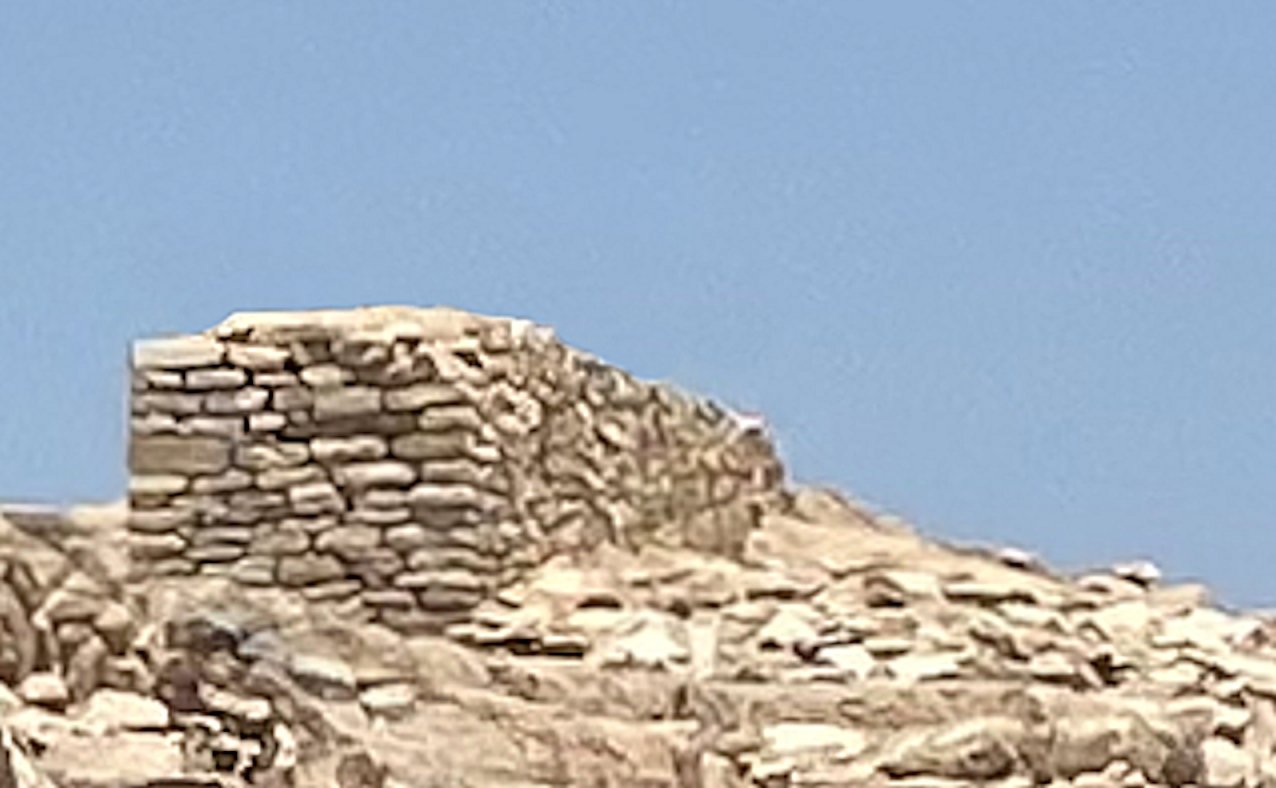
The confusion is easy to understand once you stand there. The Shimao ruins run for kilometres across a series of ridges and gullies, low grey ramparts of dressed stone half-buried in yellow earth. Shaanxi is threaded with old defensive walls from many centuries, and to a casual eye these looked like just another stretch of them. Locals had been carrying jade out of the ground since at least the 1920s, and a few scholars had noted the place, but nobody grasped the scale.
Systematic excavation, begun in 2011 under the Shaanxi Provincial Institute of Archaeology, changed that quickly. Radiocarbon dates placed the founding of the city at around 2300 BC, with the main occupation running to about 1800 BC, when it was abandoned. That puts Shimao squarely in the late Neolithic, in the period Chinese archaeologists call the Longshan, and makes it a contemporary of the pyramids of Egypt and the great cities of the Indus Valley. The Great Wall as most people picture it would not begin to take shape for another eighteen centuries.
What the excavators uncovered was not a fort or a garrison but a planned settlement of extraordinary size: roughly four hundred hectares, four square kilometres, laid out in three parts. There was an outer city, an inner city, and at the heart of it a walled central mound that the team named Huangchengtai, the "Emperor's Terrace." No walled town of comparable scale is known anywhere in East Asia at that date. Shimao was, quite simply, the biggest thing of its kind in the ancient Chinese world.
The terrace at the centre
The Emperor's Terrace stops people in their tracks. It is a stepped platform of rammed earth faced with stone, rising in tiers to a height of around seventy metres and covering some twenty-four hectares at its base. Western headlines called it a pyramid, and while it is not a smooth-sided Egyptian pyramid, the comparison is not silly: it is a monumental stepped structure, deliberately raised, with a palace precinct on top.
Getting the stone into place was a colossal undertaking. The builders quarried and shaped millions of blocks and stacked them without mortar, relying on careful fitting and the weight of the wall itself. The terrace was not merely a foundation. It was a statement: a platform lifting the ruling class physically above everyone else, visible for miles across the plateau. On its summit the archaeologists found the remains of large buildings, workshops, and quantities of luxury material: jade, painted pottery, and the debris of a court that controlled the region.
The stone masons of Shimao understood decoration as well as engineering. Set into the faces of the terrace walls they left carved stone reliefs and, remarkably, coloured murals painted in red, black, yellow and orange geometric patterns. These are among the earliest wall paintings ever found in China, decorating a building raised centuries before the first Chinese dynasty that historians can securely name.
Jade in the walls
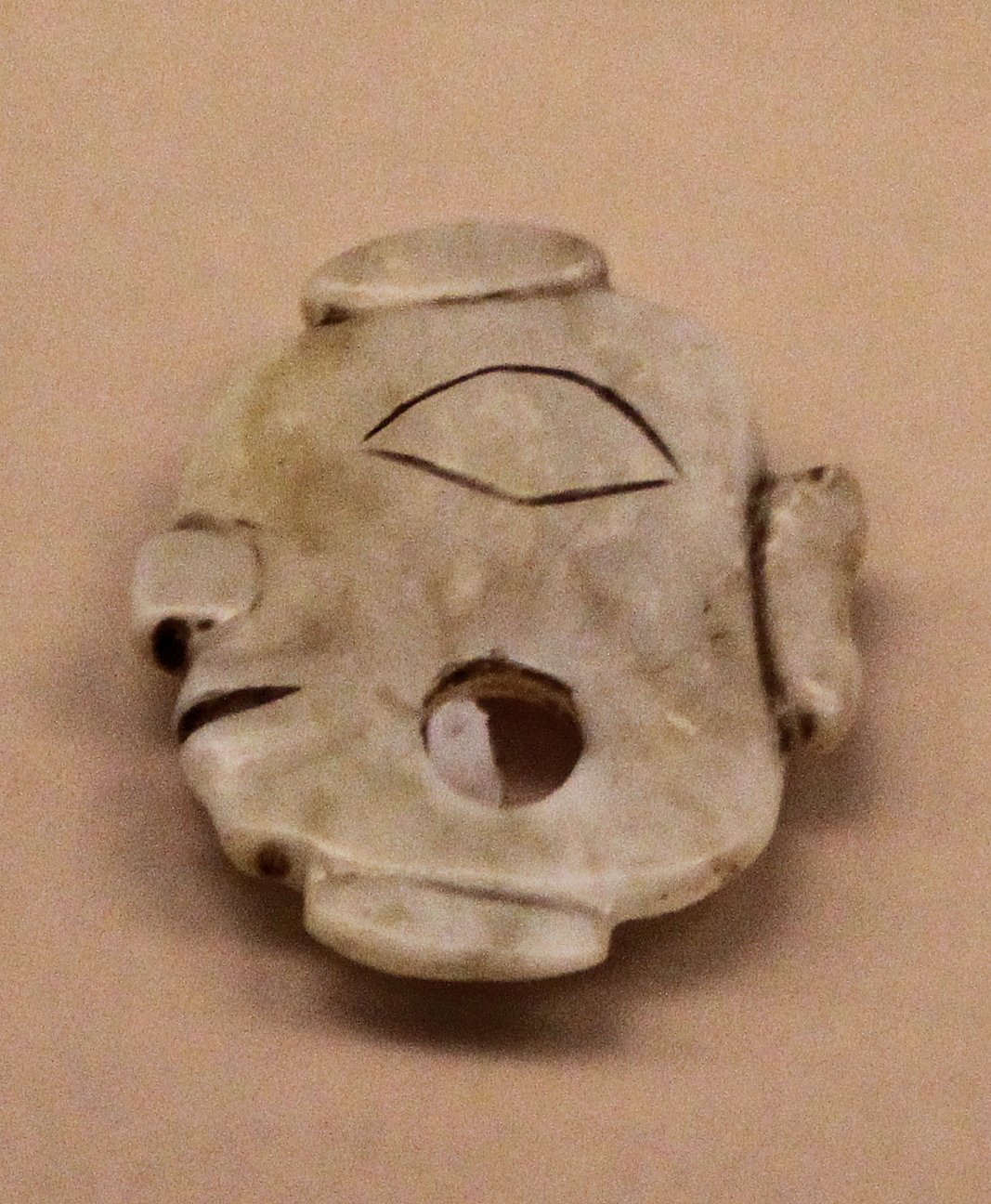
The jade is the detail that first hinted something unusual was going on, and it remains one of the strangest features of the site. Shimao's builders pushed their jade into the walls, slotting blades, discs and other worked pieces into the gaps between the stones as the ramparts went up.
This was not accidental loss. The placement is deliberate and repeated, and it appears in structures across the city. The most striking objects are the yazhang, long slender blades of polished stone with a notched handle, made in a form that turns up much later at sites right across China and beyond. To find them built into a wall on the northern frontier, a thousand years before they became widespread, forces a rethink of where such prestige objects came from.
What makes it stranger still is that jade is not native to this corner of Shaanxi. The nearest sources lie hundreds of kilometres away. Every piece embedded in those walls had to be carried a great distance, worked by skilled hands, and then, apparently, given up to the stone. The likeliest explanation is that the jade was protective, a way of guarding the walls, and the city, against harm. But the honest answer is that we are looking at a belief system whose logic we can only guess at.
Faces in the stone
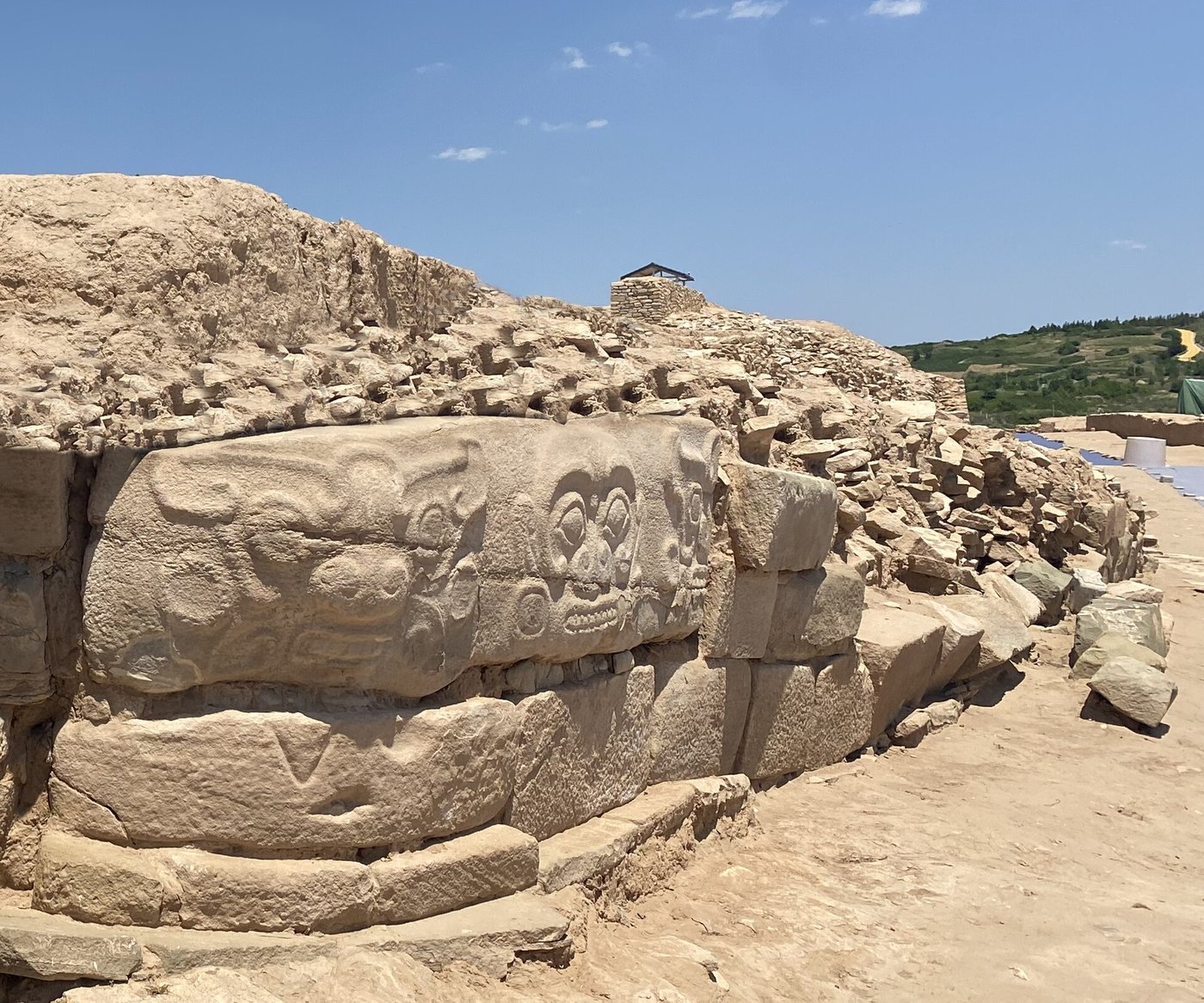
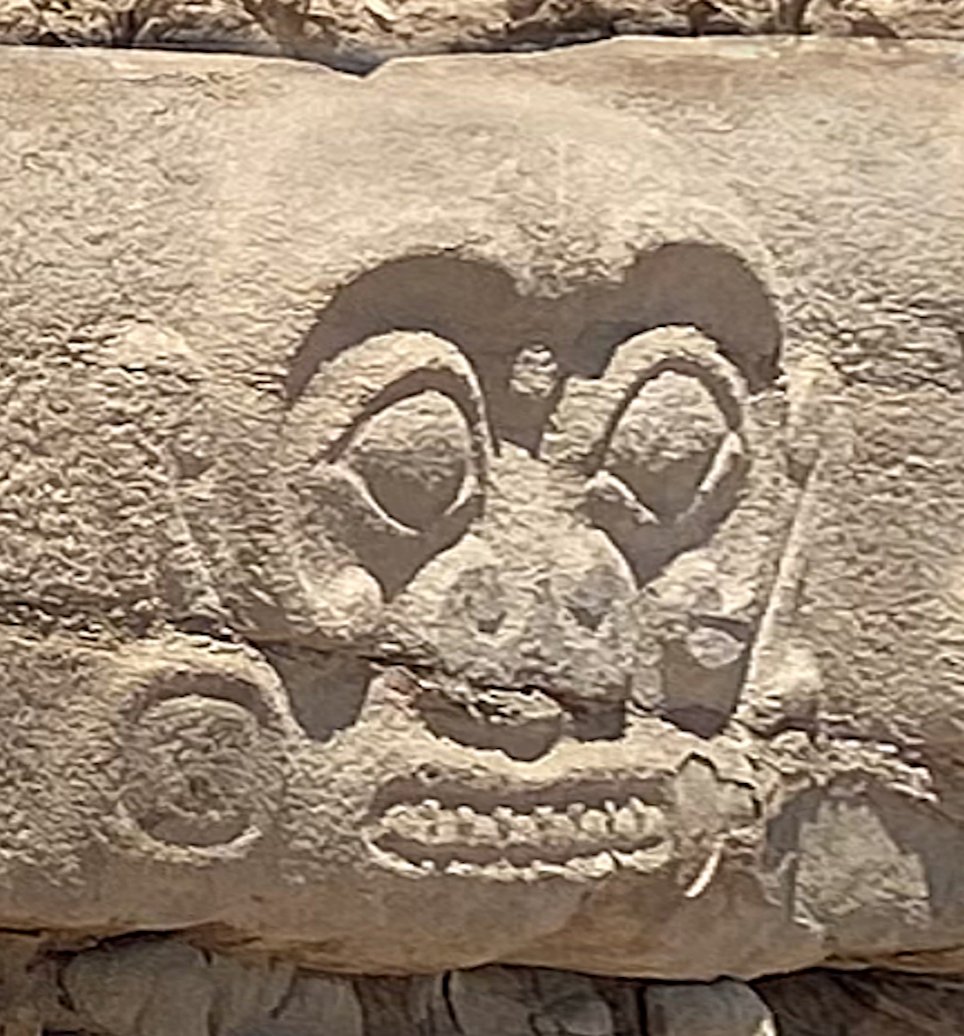
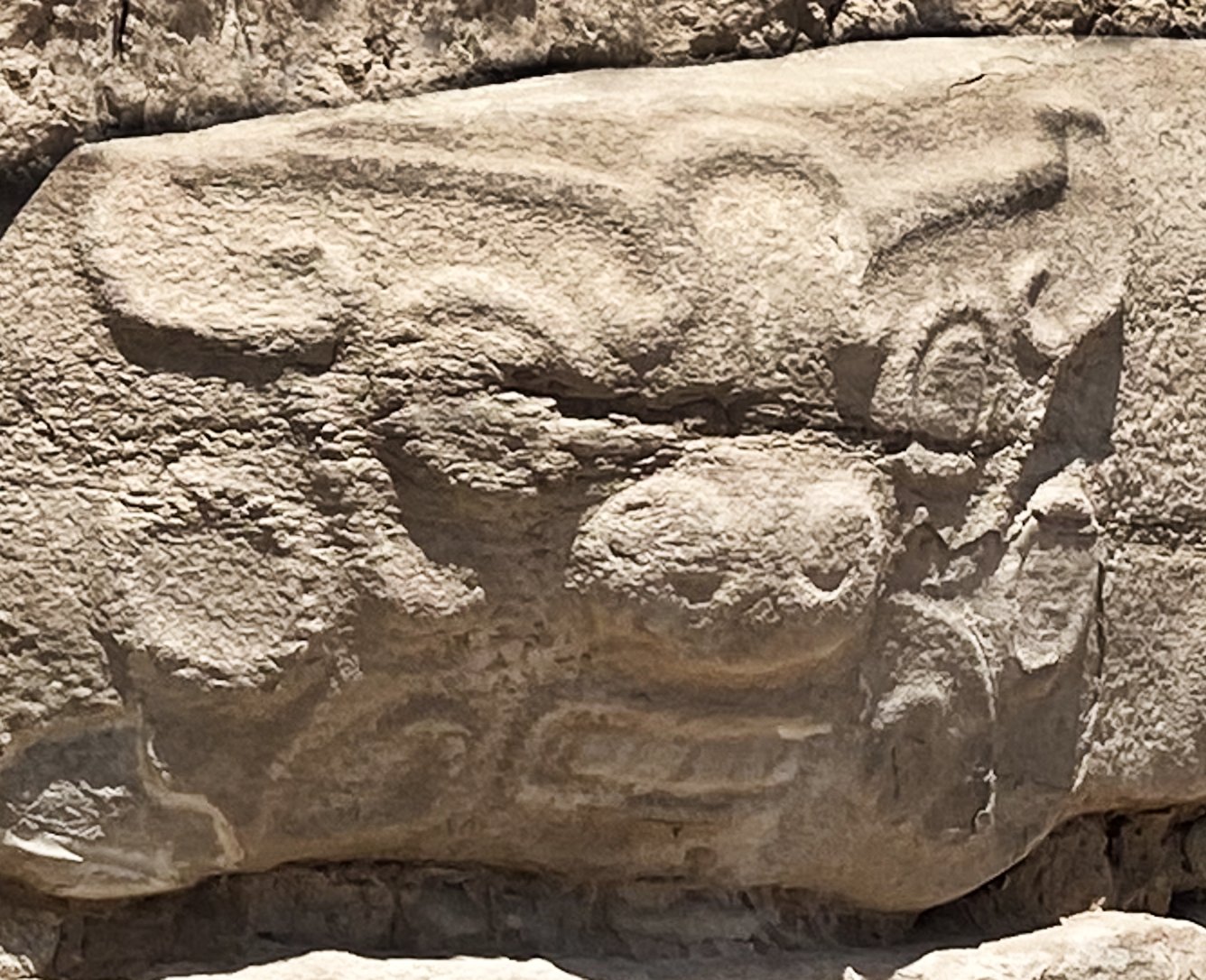
As the eastern gate emerged from the soil, the excavators began to notice something on the wall stones: faces. Carved into flat slabs and set into the masonry were human and animal images: staring eyes, broad monster-like masks, figures with elaborate features. Some are simple line carvings; others are fully modelled reliefs. A number of freestanding stone sculptures were also recovered, including columns carved with human heads.
These carvings are not decoration scattered at random. They cluster at the gates and along the most important walls, exactly where a community would want to mark a boundary between inside and outside, safe and dangerous. Gates were the vulnerable points of any walled city, in a practical sense and very likely in a spiritual one too. The eyes and masks worked into the Shimao gateway look like guardians, watching the threshold. Whatever the people of Shimao believed was out there, they built their defences to face it on more than one level.
The pits beneath the gate
The darkest discovery came at the outer eastern gate. Beneath and around its foundations, the archaeologists found pits filled with human skulls, dozens of them, separated from their bodies. In the first pits opened, roughly eighty severed heads were counted, and analysis of the earliest finds suggested they belonged largely to young women, some barely more than girls.
The context points to sacrifice. The skulls were placed as the gate was being built, which fits a grim and widespread ancient practice: killing people to consecrate the founding of a major structure, so that their deaths would somehow bind and strengthen it. Some of the victims may have been captives taken in war. Whoever they were, they were killed and their heads buried in a deliberate ritual at the most important entrance to the city. This is the earliest clear evidence of large-scale human sacrifice yet found in China.
"The Shimao remains represent the largest known walled settlement of its time in ancient China, revealing a level of social complexity and ritual violence that reshapes our understanding of early state formation."— summarising the findings of the Shaanxi Provincial Institute of Archaeology excavations at Shimao
Reading the foundation pits
For a decade, the image that stuck in the public mind was of the young women beneath the eastern gate. Then, in July 2026, a team led by Professor Qiaomei Fu of the Chinese Academy of Sciences published a large study of ancient DNA from Shimao in the journal Nature, and the picture grew more complicated.
The researchers recovered genetic data from 169 ancient individuals (144 of them unrelated) from Shimao and nearby sites. When they examined the wider sacrificial burials across the city, they found that these mass graves were made up largely of men. That does not erase the earlier finding about the women at the gate; the two may reflect different rituals, carried out at different places and moments in the city's life. But it warns against turning a single, vivid discovery into the whole story. Sacrifice at Shimao was not one act with one kind of victim. It was a recurring institution, and its victims were varied.
"Shimao's human sacrifices were all young women, killed to consecrate the city — a single, uniform horror at the eastern gate."
The famous foundation pits at the eastern gate did hold many young female skulls. But the 2026 genome study of the broader mass burials found them to be largely male. Sacrifice at Shimao was a repeated practice across the city, with different victims in different contexts, not one event that can be summed up in a single sentence.
Where the people came from
The same DNA study answered a bigger question: who were the people of Shimao, and where had they come from? For a city this unexpected, in a place the textbooks treated as a backwater, one tempting answer was that its rulers were outsiders: migrants or conquerors who had swept in from the steppe or somewhere further afield, bringing their monumental habits with them.
The genetics say otherwise. The Shimao population descended mainly from the earlier local inhabitants of northern Shaanxi, the Late Yangshao farming communities who had lived in the region for a thousand years already. This was continuity, not invasion. The people who built the terrace and carved the faces were, by and large, the great-great-grandchildren of the people who had farmed the same hills long before.
Still, they were not isolated. The study found close genetic links between Shimao and the Taosi culture to the south-east, in the Fen River valley of Shanxi, another major Longshan centre. It also detected connections reaching further, towards steppe pastoralists to the north and rice-farming populations to the south. Shimao was a local society with deep roots, but it sat at a crossroads, tied into a web of contact that stretched across much of what would later become China.
Rewriting the cradle
The reason Shimao matters so much to specialists is that it breaks a story they had told for a very long time. In the traditional account, Chinese civilisation had a single heartland: the Central Plains along the middle Yellow River, where the earliest dynasties (the Xia, then the Shang) supposedly arose and radiated culture to the surrounding "barbarians." Everything important began in the centre; the frontiers merely received.
Shimao does not behave like a passive frontier. It is enormous, sophisticated, wealthy and early, and it is a long way from the supposed cradle. Together with sites like Taosi in Shanxi and the jade-rich Liangzhu culture far to the south-east (a Neolithic society whose waterworks and jade have earned it World Heritage status), Shimao supports a very different model. In this view, complex societies were rising in several regions at once, trading, competing and borrowing from one another, and the thing we call Chinese civilisation grew out of that whole braided network rather than sprouting from one seed.
Was Shimao a state? Scholars disagree. Its scale, its monumental architecture, its craft workshops and its evidence of organised violence all point to a powerful, hierarchical society capable of commanding huge amounts of labour, the hallmarks many use to define an early state. Others urge caution: without written records we cannot know how it was governed, whether it ruled a wide territory or only itself, or what its rulers called themselves. What is not in dispute is that Shimao forces the origins of Chinese complexity outward and backward, away from a single centre and deeper into the Neolithic than the old story allowed.
The silence after
Around 1800 BC, after roughly five centuries, Shimao was abandoned. The reasons are not settled. The climate of the region was drying over this period, and a frontier city dependent on farming marginal land would have felt that keenly. Shifting trade, internal conflict, or the pull of rising powers elsewhere may all have played a part. Whatever happened, the people left, the terrace fell silent, and the yellow earth began to swallow the walls.
And then it was forgotten so completely that its own descendants mistook it for a stretch of the Great Wall. No text names it. No legend can be securely tied to it. For nearly four thousand years the largest city of its age in China lay in plain sight, walked over by farmers who pocketed its jade without knowing what they held. It survives now not because anyone remembered it, but because stone endures and someone finally thought to dig.
That is the quiet lesson of Shimao. History is not only the story of what was written down and passed on. It is also full of things that were built with immense effort, mattered enormously to the people who made them, and then vanished from memory entirely, waiting under a hillside for the moment someone looks again and realises the wall was never a wall at all.
Read next: Sanxingdui: The Bronze Masks With Eyes on Stalks and The Bury Tomb: How Ancient DNA Solved the Mystery of Europe's Vanished Megalith Builders.
Sources & further reading
- Fu, Q. et al., "Ancient DNA from Shimao city records kinship practices in Neolithic China," Nature (2026).
- Jaang, L., Sun, Z., Shao, J. and Li, M., "When peripheries were centres: a preliminary study of the Shimao-centred polity in the loess highland, China," Antiquity, vol. 92 (2018).
- National Geographic, "Mysterious carvings and evidence of human sacrifice uncovered in ancient China," reporting on the Shimao excavations.
- Institute of Vertebrate Paleontology and Paleoanthropology, Chinese Academy of Sciences, press materials on the Shimao genome study (2026).
- Shaanxi Provincial Institute of Archaeology, excavation reports on the Shimao site and the Huangchengtai terrace.
Image credits (via Wikimedia Commons): Shimao stone wall, animal-face relief and stone figure — Bilaterian (CC BY-SA 4.0); Shimao jade portrait — Gary Todd (CC BY-SA 4.0).