One day in 1739, in the sacked and burning city of Delhi, someone in Nadir Shah's army seems to have pointed a cannon at a pillar of iron and fired at close range. The shot should have shattered it, or at least knocked it flat. Instead the ball glanced off and flew into the stone screen behind, and the pillar kept standing. It is standing there still. Run your eye up the shaft today and you can find the wound the gun left: a shallow dent, about four metres up, in metal that has otherwise shrugged off cannon fire, monsoon after monsoon, and sixteen full centuries of open sky.
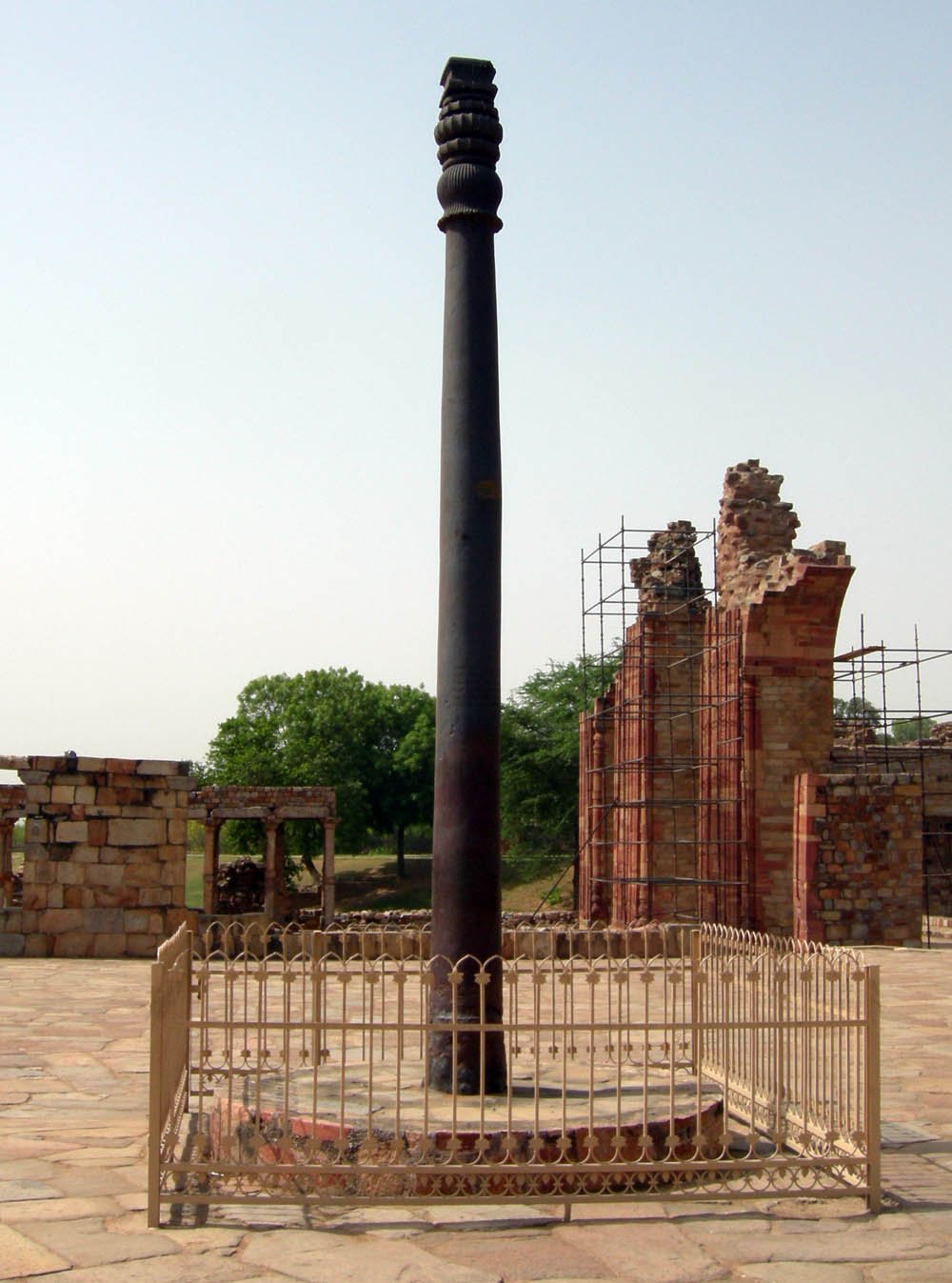
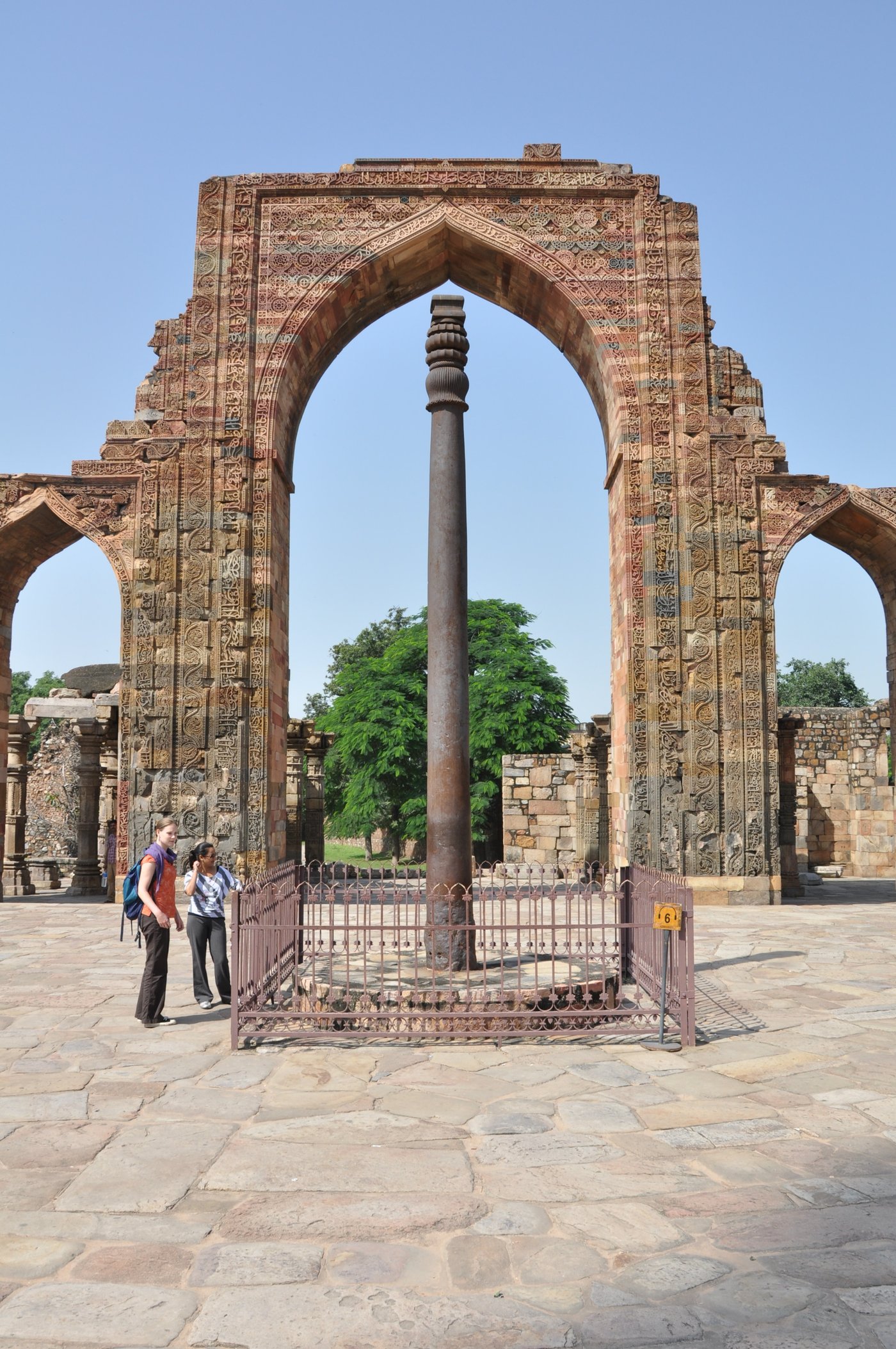
The thing that survived all this is not large or grand. It is a plain dark column a little over seven metres tall, standing in a paved courtyard in Mehrauli, in the south of Delhi, ringed now by a low railing and watched by tour guides who have the whole speech memorised. Most visitors come for the towering Qutb Minar next door and give the pillar a passing glance. Then the guide says the sentence that stops them: this iron is about sixteen hundred years old, it has stood in the weather the whole time, and it has barely rusted.
That single fact has grown a forest of legends around it. The pillar has been called proof of a lost science, a gift from visitors who were not from here, a secret the old smiths took to their graves. The truth is quieter and, in its way, more impressive. People with no furnaces worth the name, no chemistry, no idea what an atom was, made a piece of iron that has outlasted every empire that has ruled the ground it stands on. How they did it, and why the rust never came, took modern science a surprisingly long time to work out.
A column that outlived its own empire
Start with the plain measurements, because they are stranger than they look. The pillar stands 7.21 metres tall, of which just over a metre is sunk below the courtyard floor. It is about 41 centimetres across at the foot and tapers to roughly half that near the top, where it finishes in a decorated capital shaped like an upturned bell. It weighs more than six tonnes. And it is not cast. There was no mould, no furnace big enough to melt six tonnes of iron and pour it. Every kilogram of it was made in small hot lumps and hammer-welded together by hand.
Hold that picture for a moment. Iron does not melt at any heat an ancient forge could reach. What early smiths made was a spongy, half-solid mass called a bloom, pulled glowing from a clay furnace and beaten to drive out the slag. To build a single column this size, workers had to forge a great many of these blooms and weld them onto one another, blow by blow, keeping the joins sound the whole way up. The surface still carries the faint marks of the process. It was, by any measure, one of the most ambitious pieces of ironwork anywhere in the ancient world, and it was made to stand in front of a temple, not to be admired as engineering.
The empire that ordered it was the Gupta, which ruled much of northern India in the fourth and fifth centuries and is often called a golden age of the subcontinent: a time of confident sculpture, mathematics, and the astronomy that first set out the earth turning on its axis. The pillar belongs to that world. It was never meant to be a puzzle. It became one only because it refused to age on the same schedule as everything around it.
The king remembered only as Chandra
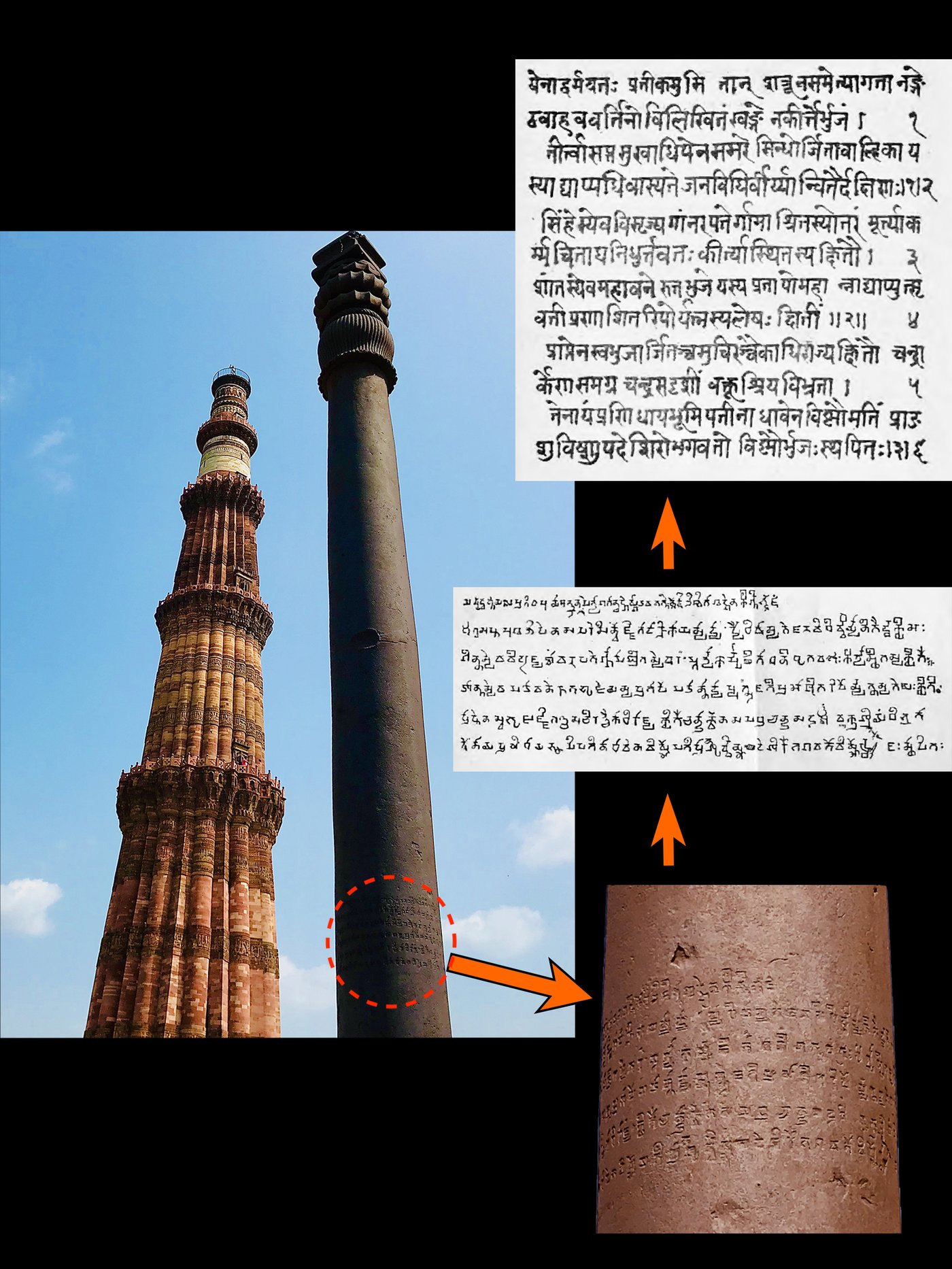
Cut into the shaft, a little above head height, is a block of six lines of Sanskrit verse in the elegant Gupta script. It is the oldest thing about the pillar we can actually read, and it names no date and only one man: a king called simply Chandra.
The verses do what royal inscriptions did. They boast. They say this Chandra crossed the seven mouths of the Sindhu and beat back a confederacy of enemies in the land of Vanga, in the east. They say the breeze of his courage still stirred the far southern ocean. And they say that when he had won his fame and left the earth, this standard was raised on a hill in honour of the god Vishnu. The pillar, in other words, began life as a religious object, a dhvaja or divine banner-staff, and the iron shaft we see is only the pole. Something stood on top of it once, almost certainly a figure of Garuda, the eagle who carries Vishnu through the sky. The socket that held it is still there at the summit, empty.
"He, on whose arm fame was inscribed by the sword, when he, in battle in the Vanga countries, kneaded back the enemies who, uniting, came against him… he, by whom, having crossed in warfare the seven mouths of the Sindhu, the Vahlikas were conquered." — from the pillar's own inscription, praising the king it calls Chandra, in the flat translation of the epigraphers who first puzzled it out.
Which Chandra? The overwhelming favourite is Chandragupta II, the Gupta emperor who reigned around the turn of the fifth century and who took the title Vikramaditya, "sun of valour." The style of the lettering fits his reign. The conquests fit the reach of his empire. Nothing about the identification is certain (the pillar keeps its date to itself), but if it is right, the iron was forged around the year 400, give or take a few decades. That would make it a contemporary of the last Roman emperors to rule a unified empire in the West.
The hill it was carried down from
Here is a fact that trips up almost everyone who reads about the pillar: it was not made in Delhi, and the courtyard it stands in is centuries younger than the iron. The Quwwat-ul-Islam mosque around it was raised at the end of the twelfth century, on the site of an older set of temples, by the first sultans of Delhi. The pillar was already ancient by then. It was brought here, set up as a prize, and the victors built their mosque around it.
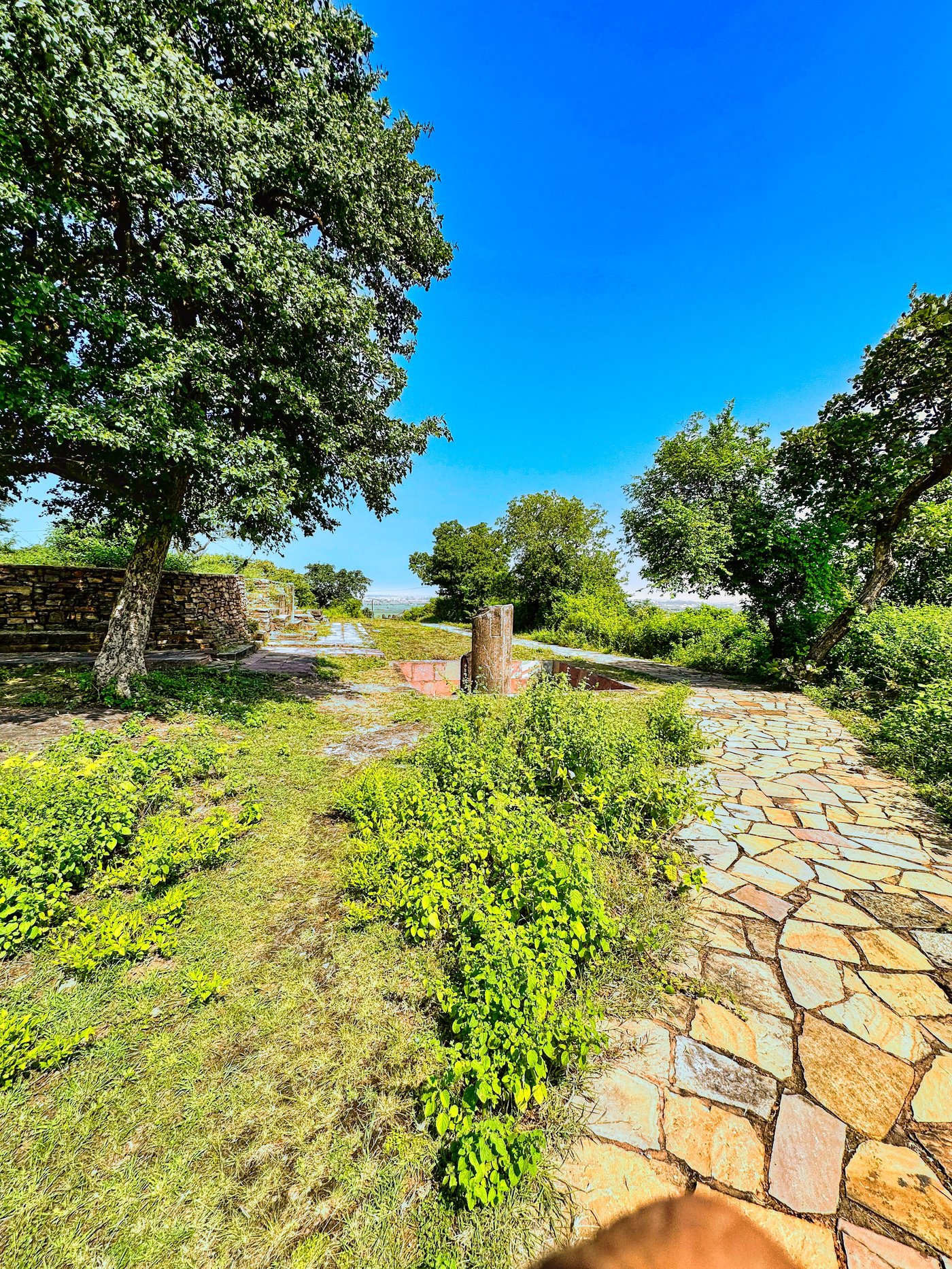
Where it came from before that is an open question. The inscription says it was planted on a hill it calls Vishnupada: "the footprint of Vishnu." No such place is named in Delhi. The best modern guess points hundreds of kilometres south, to the sandstone ridge of Udayagiri near Vidisha in Madhya Pradesh, a site soaked in Gupta royal religion, carved with Vishnu in his boar form and closely tied to Chandragupta II himself. If that is right, the pillar once stood in the country where it was made, watching over a shrine, before history dragged it north.
How it got to Delhi, and who moved it, is a second argument stacked on the first. The nineteenth-century surveyor Alexander Cunningham credited a Tomar king, Anangpal, in the eleventh century, and a local legend still ties the pillar to that dynasty. Other scholars point to Iltutmish, the sultan who finished the mosque in the early thirteenth century, and who may have hauled the trophy home after sacking a city in the south. A six-tonne iron column does not travel by accident. Somebody wanted it badly enough to move it, and left no clear note of how.
Two candidates, centuries apart, are still offered for the pillar's journey to Delhi: the Tomar king Anangpal in the eleventh century, and the sultan Iltutmish in the early thirteenth. The truth may be stranger than either (moved once, then again), and the surviving records are too thin to settle it. What is not in doubt is that the iron reached its present spot as a captured wonder, older than the mosque that now frames it, and was kept precisely because it was already famous.
Why the rust never came
Now the real question, the one the legends grow out of. Bare iron left in the open is supposed to lose. Oxygen and water get at it, rust blooms, the rust flakes away, fresh metal is exposed, and the whole thing eats itself down to a stain. That is the fate of an ordinary iron post in a Delhi garden inside a human lifetime. The pillar has stood through roughly sixteen hundred monsoons and is still sound iron to its core. What is different about it?
The person who did the most to answer that was R. Balasubramaniam, a metallurgist at the Indian Institute of Technology in Kanpur, who spent years on the pillar and set out his case in the journal Corrosion Science in the year 2000. His answer has three strands, and none of them is magic.
The first is what the iron is made of. The pillar is close to pure iron, but it carries an unusually high dose of phosphorus: around a quarter of one per cent, where modern structural iron keeps it below a twentieth of that. Phosphorus is normally a nuisance a steelworks tries to remove. But the old Indian smiths worked their bloomery iron without lime, the flux a modern furnace uses to strip phosphorus out, so the element stayed in the metal. And phosphorus, left in, helps iron grow a skin that protects it.
The second strand is that skin itself. On the pillar's surface, over centuries, a thin dark film built up: a crystalline layer of iron hydrogen phosphate, dense and even, sitting tight against the metal at the very place where rust would normally form. A short-lived compound called misawite forms first and seeds it. Once the phosphate film sets, it seals the surface and slows everything beneath it almost to a stop. Balasubramaniam measured its growth. In sixteen centuries the protective layer has thickened by about one-twentieth of a millimetre, thinner than a sheet of paper.
The film that guards the pillar is not thick. Measured against the age of the iron, it has crept forward at a rate almost too small to picture: roughly 0.05 millimetres of growth in around 1,600 years. That is the whole margin between a column that has lasted since the Gupta age and one that would have rusted to a stump long before the mosque was built around it.
The third strand is the sky over Delhi. The city is dry for most of the year and soaked only during the monsoon. That rhythm, long spells of dry heat broken by bursts of wet, turns out to be exactly what the phosphate film needs. Each wetting lets the protective layer reform and settle; each long drying spell locks it in place. A pillar of the same iron standing on a wet coast, in air thick with salt, or in a modern industrial haze of acid rain, would not have fared nearly so well. The metal, the film, and the climate had to line up. In Delhi, for a very long time, they did.
The story that the old smiths knew something we have lost
People want the pillar to be a miracle, and it is easy to see why. A rust-proof column made by hand before the fall of Rome makes a better tale than a lucky meeting of phosphorus and weather. So the legends run ahead of the metal. You will hear that ancient India held a secret of iron the modern world cannot match, that the recipe died with its makers, that no one can reproduce it. Some tellings go further and hand the credit to visitors from the stars.
"The pillar proves the ancients possessed a lost science of metallurgy that we still cannot equal. The formula for its rust-proof iron died with the smiths who made it, and modern industry has never been able to copy it."
The pillar is understood. Its high-phosphorus iron, its phosphate skin, and Delhi's dry-then-wet climate together explain its survival, and each part has been measured. Modern industry does not copy the recipe not because it can't, but because it has no reason to: deliberately loading iron with phosphorus makes it brittle and hard to work, a bad trade for most uses. The pillar's makers were skilled beyond doubt. But they were not guarding a secret the world has lost. They were doing what their process did anyway, and the climate did the rest.
The real achievement is not a lost formula. It is the sheer command of the forge it took to build the thing at all: to weld six tonnes of hand-made iron into one clean shaft, sound enough to survive a cannon, without a single furnace capable of melting it. That skill was real, and it was hard-won, and it needs no aliens. The corrosion resistance, meanwhile, is a happy accident of how that iron was smelted, sitting in the right weather. Both things can be true. The smiths were remarkable. The rust story is chemistry, and we can read it.
There is one honest complication worth keeping. The pillar is not perfectly untouched. The buried foot of it, down in the damp soil, has corroded far more than the shining shaft above, proof, if any were needed, that the open-air magic depends entirely on staying dry between rains. The pillar is rust-resistant, not rust-proof. Take away the climate and the film has nothing to work with.
The arms that wore it smooth
For most of its life in Delhi the pillar was something you touched. A tradition grew up that if you stood with your back to it, reached both arms behind you, and managed to link your hands around the shaft, your wish would come true. Generations of visitors tried it. You can imagine the scene: schoolchildren, pilgrims, honeymooners, everyone pressing their spine to the cold iron and straining to make their fingers meet.
All those arms left a mark. The lower part of the shaft was rubbed to a paler, smoother band by countless embraces, the oils and sweat of millions of hands slowly polishing and discolouring the very metal the phosphate film was meant to guard. In 1997 the Archaeological Survey of India put a stop to it and ringed the pillar with the railing that stands there now. The wishing is over. The iron is left to the weather again, which is the only thing it has ever been able to handle.
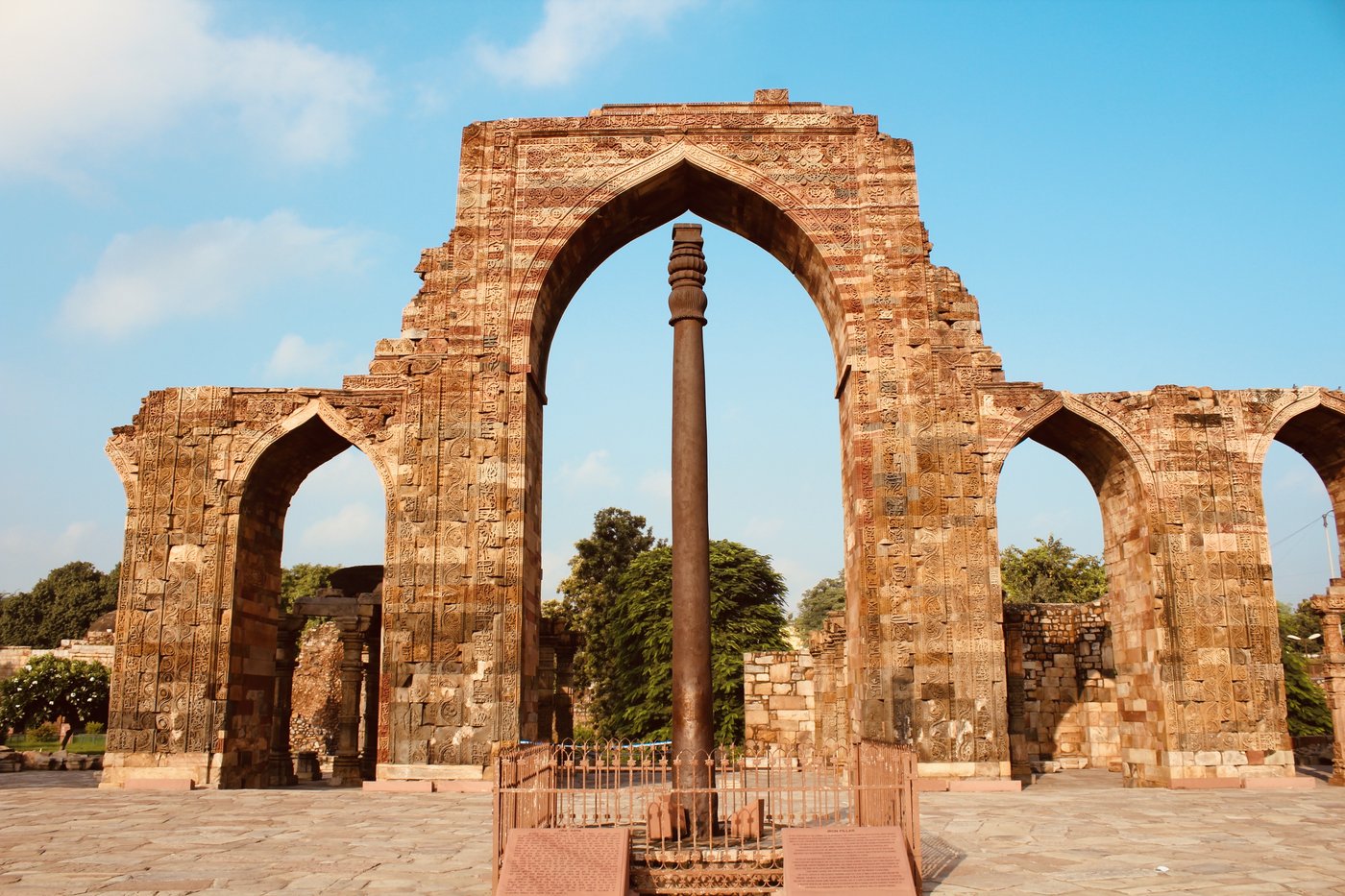
Between the cannon and the embraces, it is worth noticing what has actually threatened the pillar over the centuries. Not rust. A gunner, once, who could not break it. And a river of well-meaning hands that did more visible harm in a few generations than the monsoon managed in a millennium and a half. The weather it was built to face has been the gentlest thing in its long life.
What the column keeps
Stand at the railing now and the pillar gives very little away. It is dark, plain, faintly warm in the sun, marked with a line of script most visitors cannot read and a dent most never notice. It does not look like a survivor. It looks like a length of old iron somebody forgot to take down.
But that is what it is for. Everything built to impress around this courtyard (the temples that stood here first, the mosque that replaced them, the empires that ordered both) has fallen or been broken or been carried off. The one object that has come through unbroken is the plain iron pole that was only ever meant to hold up a statue of a bird. It has kept its maker's boast, kept its shape against a cannon, and kept the rust off for longer than most nations have existed, on nothing but good iron and the patience of the Delhi sky. The smiths who forged it are sixteen centuries gone and left no names. The column is their signature, and it is still legible.
Read next: The Kailasa Temple of Ellora: The Mountain Carved Into a Temple and The First Battle of Panipat: How Babur Founded the Mughal Empire.
Sources & further reading
- Balasubramaniam, R., "On the corrosion resistance of the Delhi iron pillar," Corrosion Science 42 (2000) — the central technical study of the phosphate protective film.
- Balasubramaniam, R., Delhi Iron Pillar: New Insights (Indian Institute of Advanced Study, 2002) — a book-length account of the metallurgy, inscription and history.
- "Iron Pillar of Delhi," Encyclopædia Britannica — a concise overview of the object, its composition and its dating.
- Hegde, K. T. M., An Introduction to Ancient Indian Metallurgy (1991) — context on bloomery iron and forge-welding in early India.
- Flood, F. B., Objects of Translation (2009) — on the pillar's reuse as a trophy in the Quwwat-ul-Islam mosque.
Image credits (via Wikimedia Commons): the iron pillar in full — Mark A. Wilson (public domain); the inscription of King Chandra — Ms Sarah Welch (CC0); the bell capital at the top — Aiwok (CC BY-SA 3.0); the Udayagiri Caves — Ms Sarah Welch (CC0); the pillar in the fenced courtyard — Hridya08 (CC BY-SA 4.0).