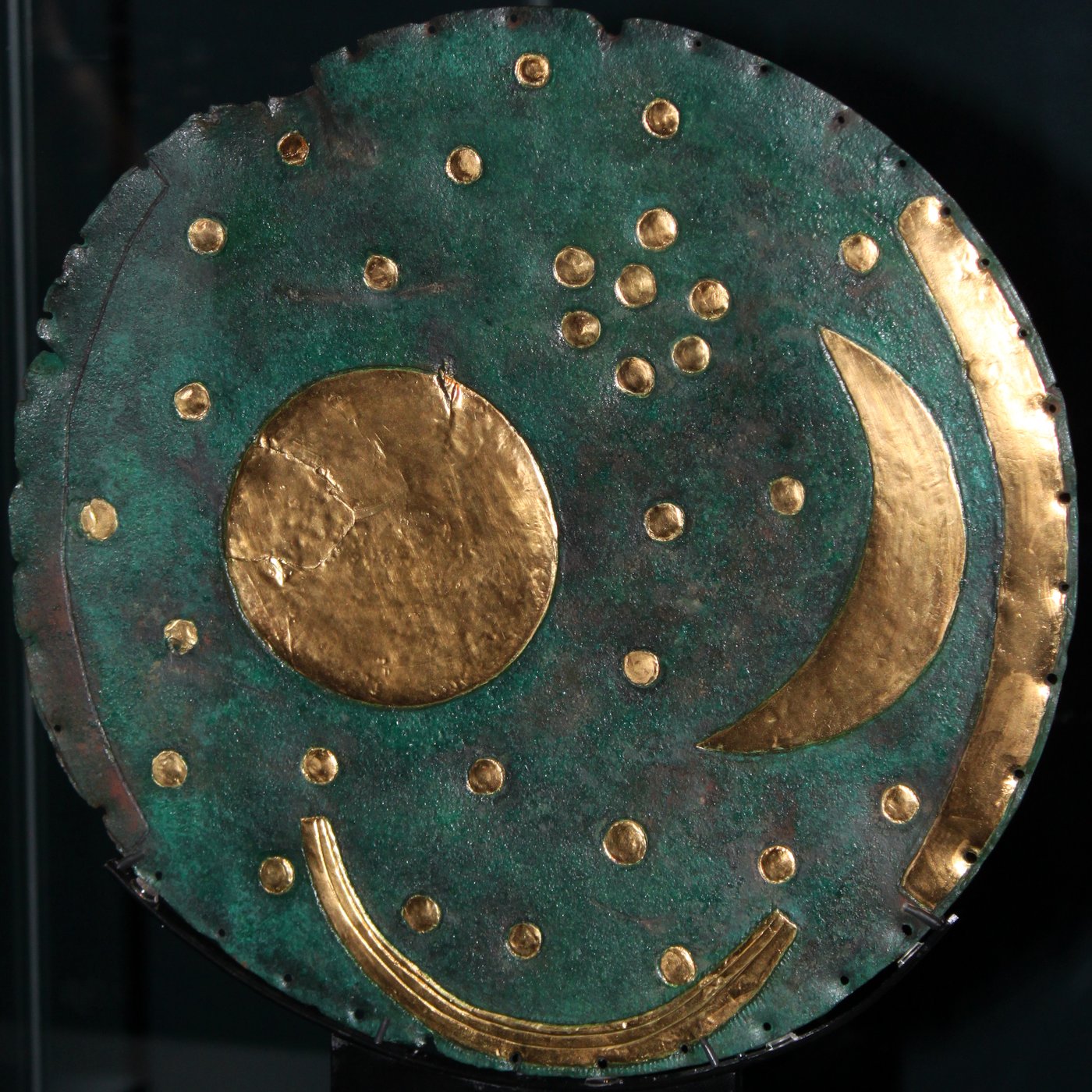
Two men were breaking the law on a wooded hilltop in central Germany one afternoon in the summer of 1999, sweeping a metal detector back and forth through the leaf litter, when the machine gave a long, clean note. They dug down with a hand tool and hit something hard. What came out of the ground was a flat disc of blue-green metal about the width of a dinner plate, and set into its face, catching the light, were shapes in gold: a full round moon, a thin crescent, and a scatter of small stars. Beside it lay swords and axes. The two men had no permit, no idea what they were holding, and no intention of telling anyone official. They wrapped up their find, climbed down the hill, and began looking for a buyer.
The disc they carried off that day is now behind glass in a museum in Halle, insured for a fortune and printed in every book on Bronze Age Europe. It has a name, the Nebra Sky Disc, and a claim attached to it that is hard to take in the first time you read it: the oldest known picture of the night sky made anywhere by anyone. Older than any Greek star chart, older than the astronomy of Babylon that survives in writing. Roughly three and a half thousand years old, made by people with no cities and no script, on a hill in what is now Saxony-Anhalt.
Getting from the hole in the ground to the display case took three years, a black market, a forged trail of owners, and a sting operation in a hotel basement in Switzerland. The science came afterwards, and it has been argued over ever since. This is the story of an object that was almost lost twice, once to looters and once to doubt, and what it turned out to be saying.
A detector, a hole, and no permit
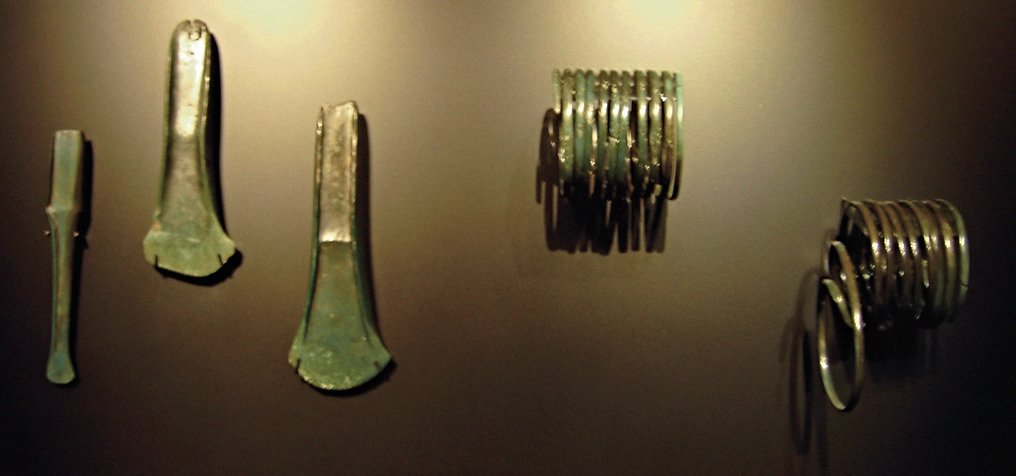
The hill is called the Mittelberg, a low forested rise near the town of Nebra, west of Leipzig. In July 1999 two men, Henry Westphal and Mario Renner, were working it with a detector, hunting for scrap and treasure the way hobbyists do, except that in the German state of Saxony-Anhalt, any find in the ground legally belongs to the state, and digging for it without a licence is a crime. They found a hoard: the disc, two bronze swords with gold-bound hilts, two hatchets, a chisel, and fragments of spiral arm-rings, all buried together.
They damaged it getting it out. The edge of the disc was chipped, and in prising the thing free they left a scar across one of the gold shapes. Then they sold the lot, fast and cheap, for 31,000 German marks: a few thousand euros in today's money for an object that is now priceless. The buyer was a dealer, and from there the hoard began to move.
For the people who study these things, this was the worst possible start. An object dug out by looters arrives with none of the information that makes a find trustworthy. No record of how deep it lay, what surrounded it, which layer of soil it sat in: all the small evidence that an archaeologist reads like a page. A licensed dig would have photographed and mapped every centimetre. Westphal and Renner had photographed nothing. When the disc finally reached scientists, it came with a black hole where its history should have been, and that hole would later be used to attack it.
The trail through the market
Over the next two years the hoard passed from hand to hand, and each time it changed owners the price climbed. Word spread through the world of dealers and collectors that something extraordinary had surfaced in eastern Germany: a bronze disc with gold stars on it, unlike anything in any collection. Some who heard about it assumed it had to be a fake. Nothing quite like it existed, and a thing with no parallel and no findspot is exactly what a clever forger would produce.
The disc suffered on its travels. Handled by people who did not know how to care for it, cleaned clumsily, it lost more of its surface. One of its gold shapes had already been damaged in the digging; the metal picked up fresh scratches. It was being treated as a commodity to be flipped, and every month it stayed on the market was another month it could vanish into a private vault abroad and never be seen again.
The man who stopped that was Harald Meller, the newly appointed state archaeologist for Saxony-Anhalt. He heard, through an intermediary, that a couple were trying to sell a spectacular bronze disc, and he understood at once both what it might be and how easily it could slip away for good. A collector was already circling. Meller decided the only way to get the disc into public hands was to go and take it, not by force, but by pretending to be exactly the sort of shadowy buyer the sellers were hoping to find.
The basement in Basel
In February 2002 the sellers agreed to show the disc to an interested party in the Swiss city of Basel, across the border and out of German jurisdiction. The meeting was set for the basement of a hotel. Meller went in playing the role of a buyer's agent, with the sum of 700,000 marks apparently on the table. Swiss police were waiting. When the disc came out and the deal was in motion, they moved in and seized it, and the two people carrying it were arrested.
That was the moment the object crossed over from contraband to national treasure. It went to Halle, to the state museum, where conservators could finally look at it properly and scientists could begin the long work of finding out what it was. The people involved in the digging and selling were prosecuted. Westphal and Renner, the finders, were convicted; their sentences, a few months each, were increased on appeal in 2003. The dealers were convicted too. The law had caught up with everyone but the disc itself, which was now safe.
Because the disc was looted, its exact resting place in the ground was never recorded by anyone who understood what they were looking at. Investigators later took the confessed finders back to the Mittelberg to point out the spot, and dug a control trench there to check their account against the soil. That reconstruction (a hole examined years after the fact, on the word of the men who had robbed it) is the closest thing the Nebra Sky Disc has to a documented findspot. Every argument about where and when it was buried has had to be built on that shaky footing.
Reading the gold
Look at the disc straight on and it is a dark blue-green circle, about thirty centimetres across and a little over two kilograms in weight, once a shining bronze that has aged to the colour of a stormy sea. Against that ground sit the gold shapes. A large round disc, which could be the full moon or the sun. A slim crescent, plainly a young moon. And thirty-two small dots: stars, scattered across the field, with one tight little group of seven set apart from the rest.
That cluster of seven is the detail that makes astronomers lean in. Seven stars, bunched close: it is very hard not to read them as the Pleiades, the small knot of stars in the constellation we call Taurus, one of the most noticeable groupings in the northern sky and a marker that farming peoples all over the world have used to time the year. If that is what the gold shows, then the disc is not a decoration or a vague sky-picture. It is specific. Someone looked up, counted, and set down what they saw.
The gold did not all go on at once. Close study of the surface shows the disc was remade in stages over a long span of use. The stars, the round body and the crescent came first. Later, someone added two curved gold bands along the left and right rims, and to fit one of them, they shifted some of the stars over, because the new band needed the room. Later still, a curved strip was laid across the bottom, often read as a boat crossing the underside of the world. Near the end of its life the rim was pierced with a ring of small holes, as if the disc was being fixed to something, or retired from whatever it had been for. It was a working object, altered by hands that kept changing their minds about it.
The seven stars and the leap month
Why would anyone go to the trouble? The most persuasive answer ties the moon and the little cluster of seven together into something useful: a rule for keeping a calendar straight.
A calendar built on the moon drifts. Twelve lunar months fall about eleven days short of a solar year, so a moon-based year slides backwards through the seasons unless you correct it, every so often, by adding a thirteenth month. The trick is knowing when. Two German researchers, Wolfhard Schlosser and Rahlf Hansen, pointed out that the disc may encode exactly that decision. When a thin crescent moon appears in the sky next to the Pleiades, the moon is at a particular width; a fuller moon in the same place means the year has drifted, and it is time to add the extra month. The disc, on this reading, is a memory aid for the one hard judgement a lunar calendar demands.
What makes the idea more than a guess is that the same rule turns up, in words, more than a thousand years later and hundreds of miles away, on Babylonian clay tablets that spell out when to intercalate a leap month using the moon and the Pleiades. If the reading holds, a piece of sky-knowledge that the Babylonians wrote down was already being tracked in gold on a German hilltop long before. Nobody can prove the makers of the disc were thinking in those exact terms. But the shapes fit the rule, and the rule is real.
Why the angle is eighty-two degrees
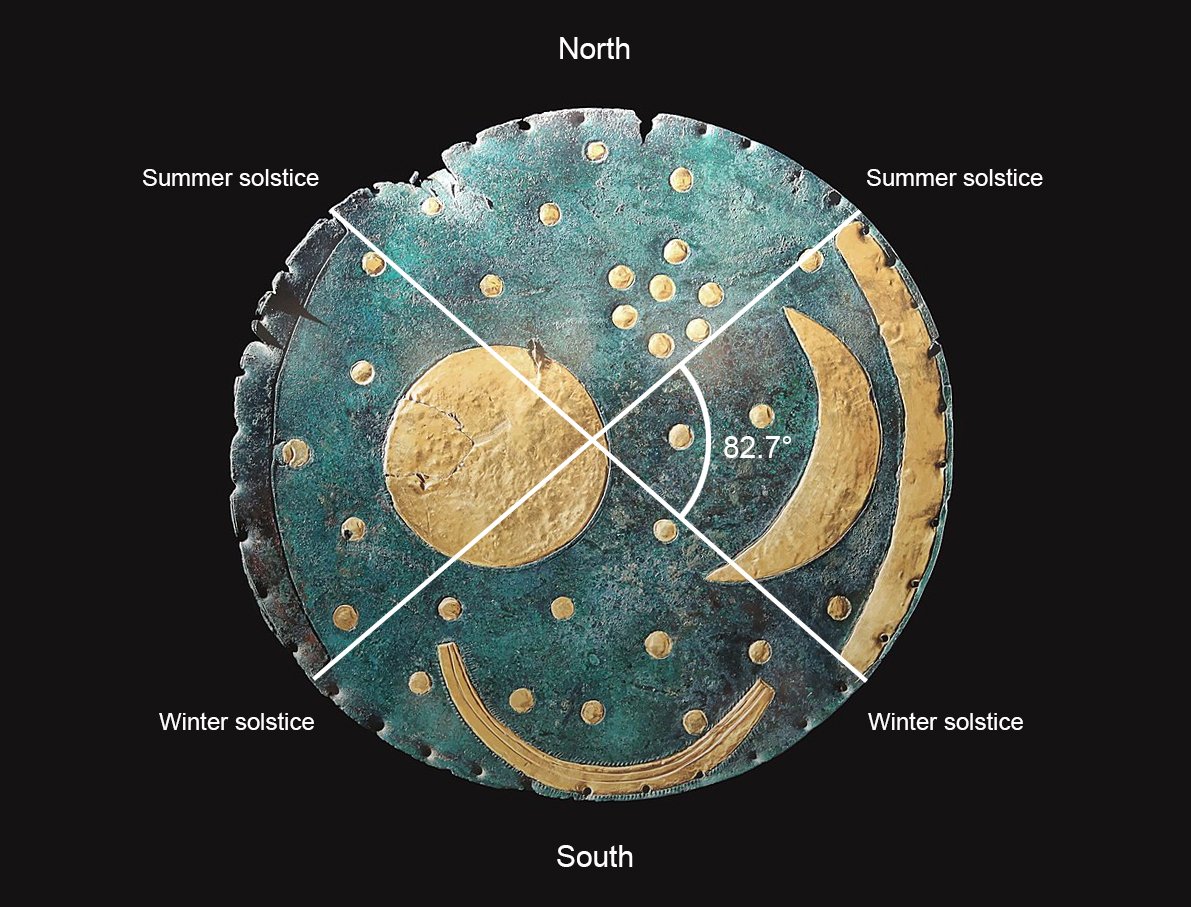
The two gold bands on the rim are what fix the disc to a place. Each one spans an arc of about eighty-two degrees. That number is not decorative. Stand on the Mittelberg and watch where the sun comes up and goes down across a full year, and its rising and setting points swing along the horizon between two extremes: furthest north at midsummer, furthest south at midwinter. At the latitude of the Mittelberg, roughly fifty-one degrees north, the gap between those extremes measures about eighty-two degrees.
In other words, the arcs are the local horizon. They mark the range the sun keeps to as the seasons turn, as seen from that exact band of the Earth. Take the disc a few hundred miles north or south and the arcs would be wrong. The people who added those bands were not drawing the sky in general; they were drawing their own sky, from their own hill, with a precision that means someone had watched the sunrise from the same spot for years to get the figure right.
The span of each horizon arc, about 82°, matches the angle between the summer and winter solstice sun as seen from latitude 51°N. That is the Mittelberg's own latitude. The arcs turn a general picture of sun and moon into a place-specific instrument, tuned to the horizon its makers actually watched. A disc made somewhere else, for someone else's sky, would carry a different number.
Alpine copper, Cornish gold
The metal has its own story, and it is a story about how far a Bronze Age hilltop reached. When scientists traced the chemistry of the disc, the copper in the bronze pointed to a mine in the eastern Alps, at Mitterberg in what is now Austria. The gold of the first stars and the tin that made the bronze harder pointed the other way entirely: to Cornwall, at the far south-western tip of Britain, and its rivers running with gold and tin. The later gold added to the disc came from different sources again, as if it had been topped up over the years from whatever precious metal came to hand.
So a single object, buried on a hill in central Germany, holds copper from the Alps, gold and tin from Britain, and an idea about the sky that would later be written down in Mesopotamia. The people who made it were not isolated villagers. They sat on trade routes that ran the length of a continent, and along those routes moved not just metal but knowledge: how to watch the sun, how to hold a calendar together, what the seven stars meant.
The date comes from the company the disc was keeping in the ground. The swords and axes buried with it belong to a well-studied Early Bronze Age world, the Únětice culture, and their style places the deposit around 1600 BCE. Scraps of birch bark found on the sword hilts, radiocarbon-dated, agree. The disc itself was probably made a century or two before it went into the earth, which fits an object that was clearly used, altered and repaired across generations before someone finally took it up the Mittelberg and put it away for good.
"A bronze disc with gold stars, unlike anything ever found, dug up by looters with no findspot and no witnesses — it is exactly what a talented modern forger would make. The safe assumption is that it is fake."
It was the obvious suspicion, and it was tested hard. The corrosion could not be faked: the disc carried a crust of malachite crystals that takes many centuries to grow, layered in a way no chemical shortcut reproduces. The gold and the bronze match Bronze Age ores and Bronze Age working, not modern refined metal. Traces of the tools used to shape and pierce it are ancient. The forgery case, pushed hard at the start, collapsed under the laboratory work. The problem with the disc was never that it was false. It was that it had been robbed.
Bronze Age, or a later hand?
That should have been the end of the arguing. It was not. In 2020 two archaeologists, Rupert Gebhard and Rüdiger Krause, reopened the whole question in print. Their case leaned on the disc's one permanent weakness: the looted, unrecorded findspot. If the disc had not really come from the Mittelberg hoard, they argued, then the tidy 1600 BCE date borrowed from the swords fell away, and the object could be far younger. They suggested it might belong to the Iron Age, a thousand years later, and be nothing to do with the bronzes at all.
The response was fast and pointed. Ernst Pernicka, who had led much of the scientific study, and Harald Meller, whose sting had rescued the thing, laid out the counter-case with the metal analyses behind it. Tiny soil traces on the disc matched soil from the sword blades. The composition of the metal sat squarely in the Bronze Age, not the Iron Age. The chemistry linked the disc and the weapons as a single buried group. Point by point, the reassessment reaffirmed the early date and the association with the hoard.
The 2020 challenge was answered by most specialists, and the Bronze Age date stands as the mainstream view. But the exchange was a reminder that the disc will never be quite as unassailable as a find lifted cleanly from a documented dig. Because Westphal and Renner robbed it, one line of attack can always be reopened: we are trusting the word of thieves about where it lay. The science has done everything science can to close that gap. The gap was made by a spade in 1999, and it does not fully heal.
What it leaves on the hill
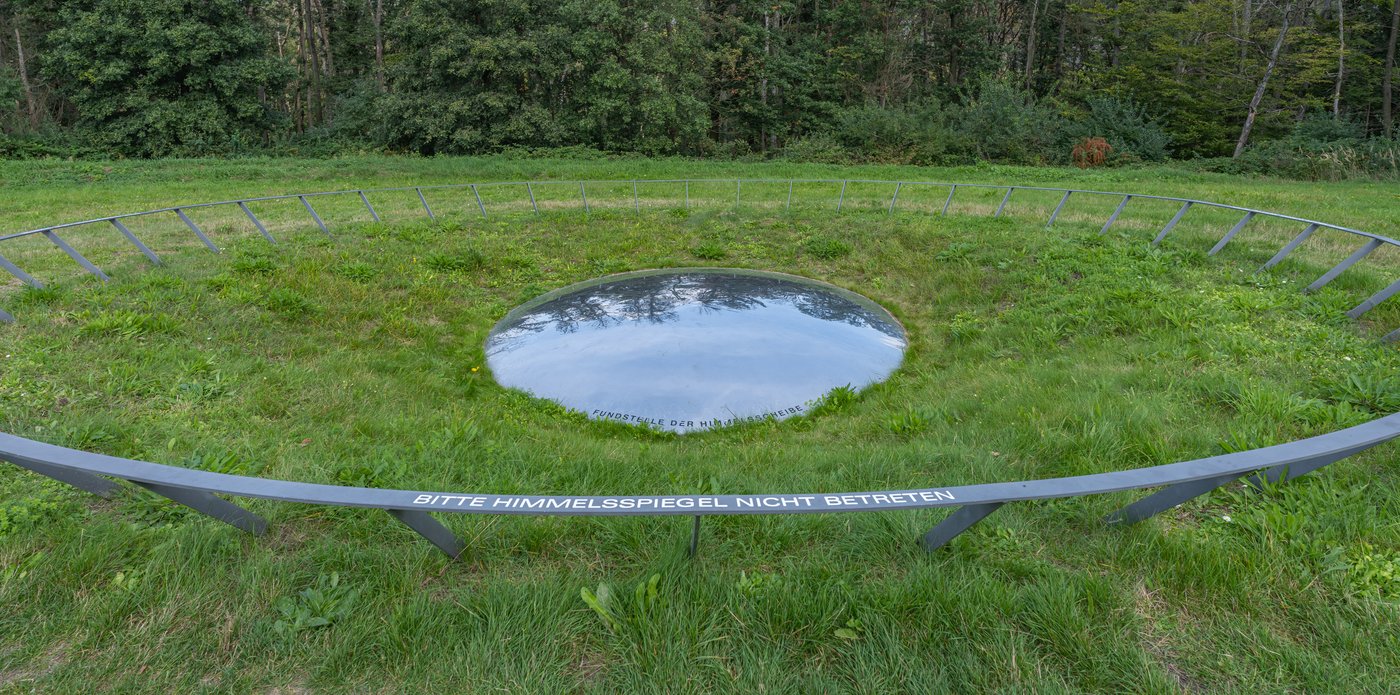
The Nebra Sky Disc went onto the UNESCO Memory of the World register in 2013, listed among the documents and objects the organisation counts as belonging to everyone. It sits now in the State Museum of Prehistory in Halle, in a dark room built to show off the gold. On the Mittelberg, where the two men dug, there is a tower and a great tilted mirror-dish marking the spot, and visitors climb the hill to look at the horizon the arcs describe.
What stays with you is not the gold or the sting or the court case. It is the patience behind the object. To get the arcs right, someone had to stand on that hill and watch the sun rise and set, season after season, for years, and remember where it stopped. To read the leap month, someone had to hold the moon and the Pleiades in mind across a lifetime of nights. The disc is the record of ordinary people paying very close attention to the sky above their own heads, and getting it right, long before anyone thought to write such things down. The sky they measured is still turning. The hill is still there. Only the watchers are gone, and this is the note they left.
Read next: Tollense: How One Arm Bone Uncovered Europe's Oldest Battle and Oxus Treasure: The Achaemenid Gold Rescued From Robbers Near Kabul.
Sources & further reading
- Meller, H., "Star search," National Geographic (January 2004) — the state archaeologist's own account of the recovery.
- Meller, H. & Michel, K., Die Himmelsscheibe von Nebra (2018) — a book-length telling of the find, the sting and the science.
- Pernicka, E. et al., "Why the Nebra Sky Disc Dates to the Early Bronze Age. An Overview of the Interdisciplinary Results," Archaeologia Austriaca 104 (2020).
- Gebhard, R. & Krause, R., "Bronze Age or Iron Age? A methodological reassessment of the Nebra hoard," Archaeologische Informationen (2020) — the challenge that was rebutted.
- State Museum of Prehistory, Halle — "Himmelsscheibe von Nebra," the museum's own pages on the object and its display.
- UNESCO Memory of the World Register — "Nebra Sky Disc" (inscribed 2013).
Image credits (via Wikimedia Commons): the Nebra Sky Disc — anagoria (public domain); the Mittelberg findspot — PantheraLeo1359531 (CC BY 4.0); the Nebra hoard — Dbachmann (CC BY-SA 3.0); the reconstructed sightline at Nebra — Frank Vincentz (CC BY-SA 4.0).