In the winter of 1955, in a workshop at the College of Technology in Manchester, an engineering professor named Henry Wright Baker fixed a roll of ancient copper into a cradle and brought a fine circular saw down against it. The metal was two thousand years old and so corroded it had set as hard and brittle as a biscuit; no one could unroll it without shattering it to green flakes. So Baker did the only thing left. He cut it. Strip by curved strip, over many careful passes, he sliced the scroll into segments a reader could lay flat, and as the first pieces came away, the man leaning over his shoulder began, at last, to read what someone had hammered into the copper before the fall of Jerusalem.
What it said was not a psalm or a prayer or a rule for holy living, which is what the other Dead Sea Scrolls had turned out to be. It was a list. Sixty-odd entries, each naming a place and the gold or silver buried there: under a staircase, inside a tomb, beneath a cistern, forty cubits down. Add the amounts together and the scroll claimed to point the way to tons of precious metal, a fortune beyond any single ancient treasury. It is the only one of the Dead Sea Scrolls written on metal rather than skin or papyrus, and it is the only one that reads like a map. In the seventy years since Baker's saw first bit into it, not a single coin from its inventory has ever been found.
A jar at the back of Cave 3
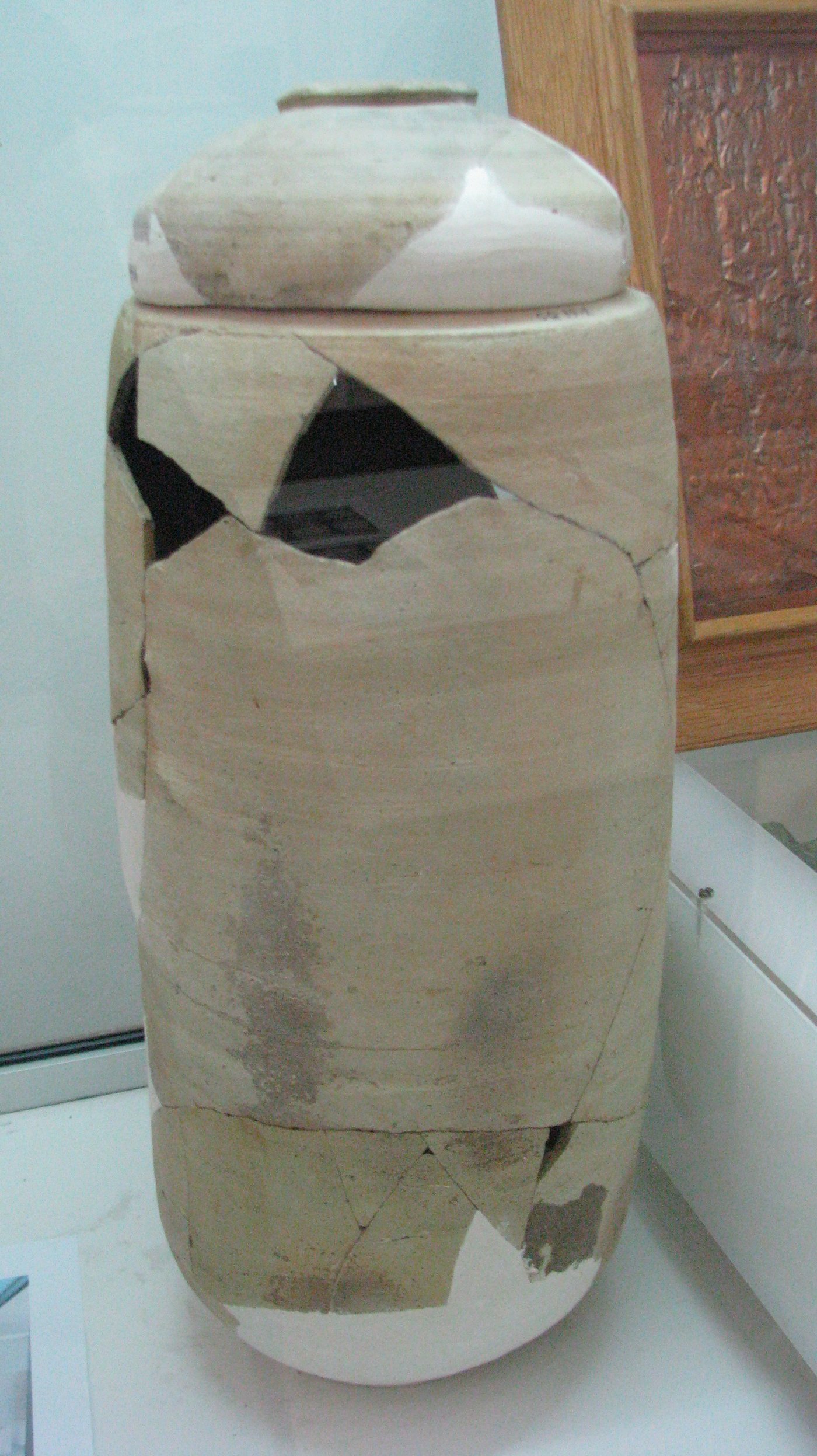
The story starts in the spring of 1952, in the dry cliffs above the north-western shore of the Dead Sea. Three years earlier a Bedouin shepherd had stumbled into the first cave near the ruins of Qumran and pulled out jars of leather scrolls, and by 1952 the hunt for more was a race between local Bedouin and teams of archaeologists working the same barren hillsides. In March, a joint expedition reached a cave now catalogued as Cave 3 and worked through the rubble on its floor. Near the back they found the remains of what had once been a shelf of pottery jars, long since smashed, and the scattered fragments of ordinary scrolls that had rotted almost to nothing in the heat.
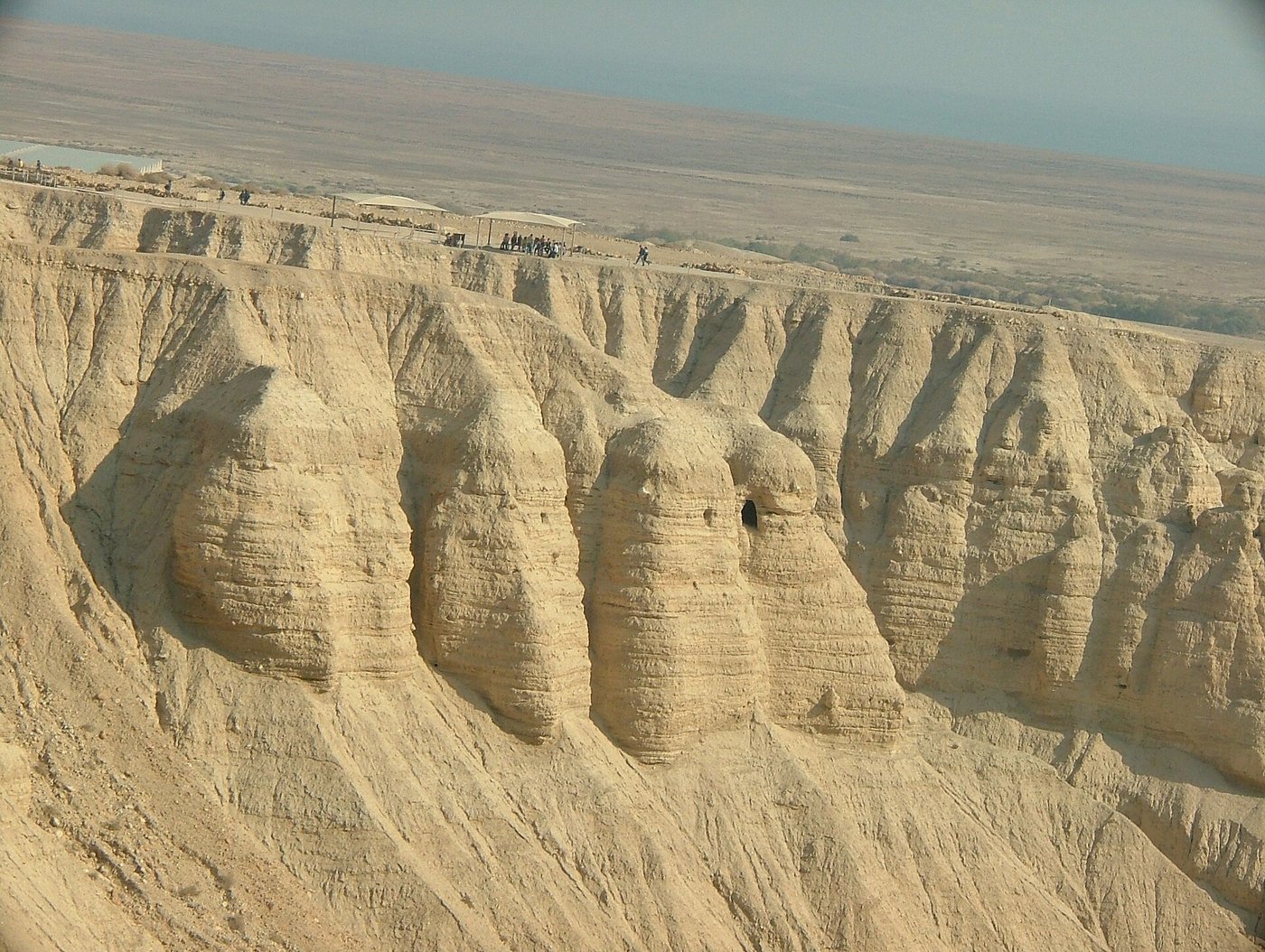
Then, against the wall, they came upon something that did not belong. Two rolls of thin copper sheet, lying one behind the other, oxidised to a dull green and clearly not a book in the ordinary sense. They were the fifteenth and final find from that cave, which is why scholars label the object 3Q15: third cave, Qumran, fifteenth item. Whoever had left it had chosen copper on purpose. Skin and papyrus perish; a shepherd's fire or a wet winter can finish them. Metal was what you used when you wanted words to survive whatever came. Someone, it seemed, had wanted these particular words to last.
The scroll that would not open
There was an obvious problem. Copper does not roll and unroll like leather. Over two millennia the metal had corroded straight through in places and lost almost all its spring, so that any attempt to prise the coils apart snapped them. For four years the two rolls sat in a museum in Jerusalem while scholars stared at the few letters embossed through to the outer surface and argued about what to do. You could see that it was Hebrew. You could see that it was writing, and a lot of it. You could not read a word of the inside.
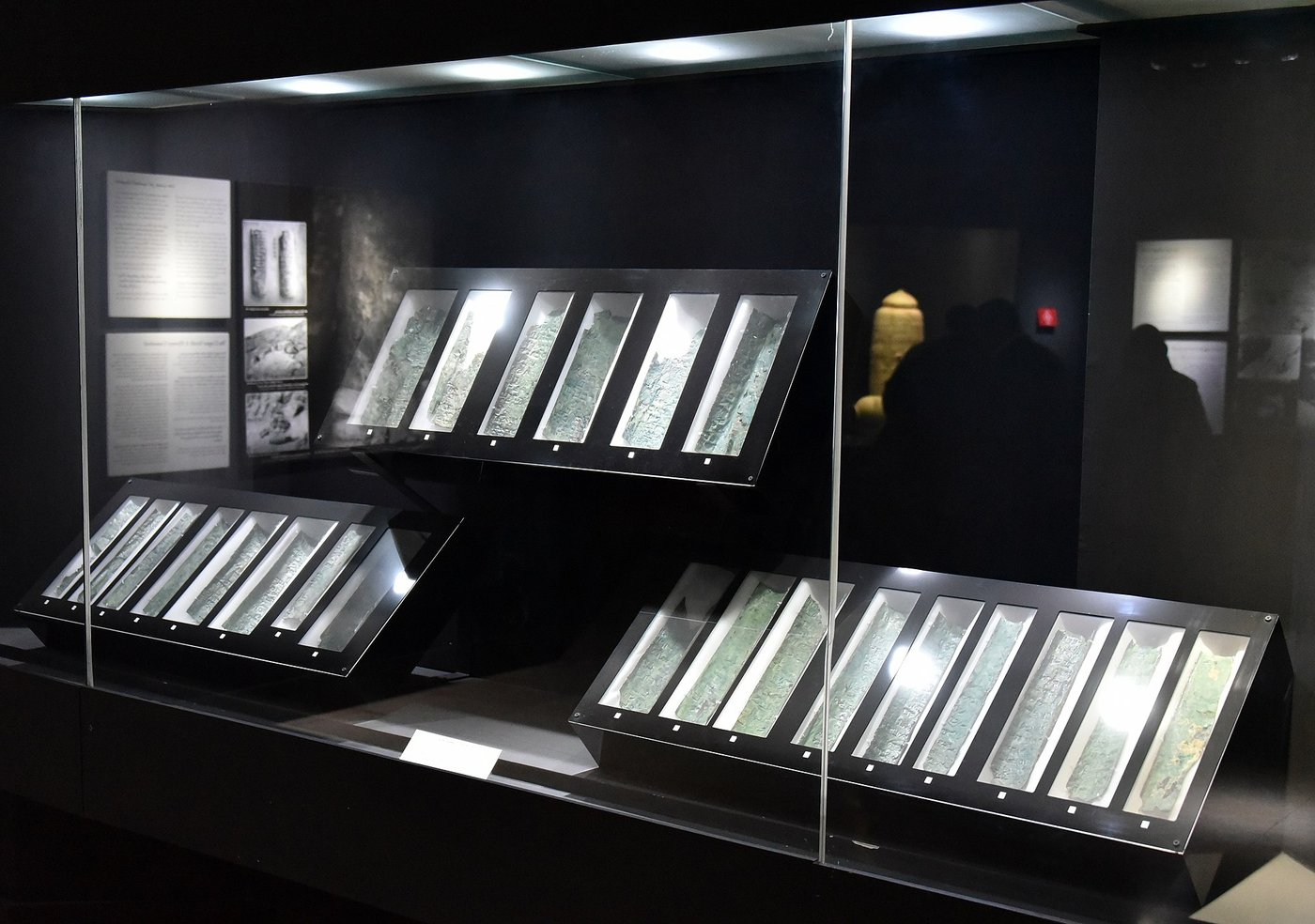
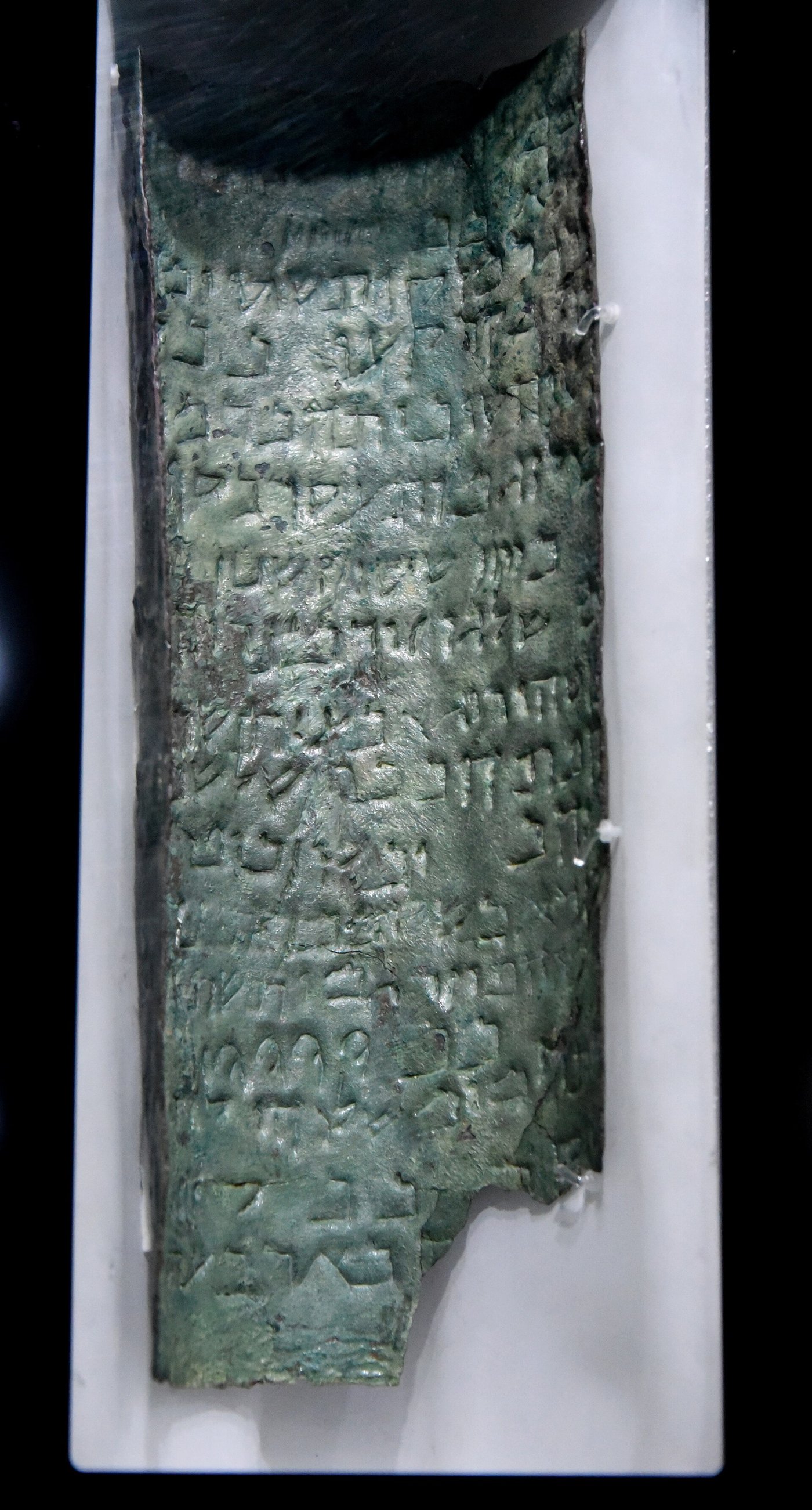
The answer came from England. On the recommendation of John Marco Allegro, a young member of the international team editing the scrolls, the object was sent to Manchester, where Wright Baker designed a rig to hold each fragile roll while a spindle saw cut it into narrow arcs. It was slow, nervous work, done in two campaigns across 1955 and 1956, and it destroyed the scroll as a physical roll in order to save it as a text. In the end Baker produced twenty-three curved strips of inscribed copper. Laid side by side, they gave up twelve columns of Hebrew, and a document unlike anything else from the caves.
Not a prayer, but an inventory
Every other scroll from Qumran fits the world of a devout religious community: books of the Hebrew Bible, hymns, commentaries, a rulebook for a sect that had withdrawn to the desert to wait for the end of days. The Copper Scroll fits none of that. Its Hebrew is closer to the everyday, workaday language that would later be written down in the Mishnah than to the polished scriptural style of its neighbours. And its subject is money.
The text is a bare register of hidden wealth. Each entry follows the same clipped shape: a location, a set of directions, then the treasure and its weight. The very first reads, in one common rendering, that in the ruin in the Valley of Achor, under the steps that face east, a chest of silver weighing seventeen talents lies buried forty cubits down. The next names another spot, another amount. The scroll goes on like that for sixty-four entries (cisterns, aqueducts, tombs, courtyards, the underside of a monument, the corner of a particular pool), each with its cache of silver, gold, consecrated vessels, or precious materials, each with a number attached.
Read literally, the sixty-four entries add up to something on the order of four thousand six hundred talents of gold and silver, a quantity of bullion so enormous that if the figures are taken at face value it would outweigh the treasuries of whole kingdoms. That single fact sits at the centre of every argument about the scroll: a hoard that large is either the greatest lost fortune in history or a number that was never meant to be believed.
Nobody expected the tidy desert monastery of popular imagination to be sitting on a ledger like this. The find forced a hard question that has never gone away. Was this an accountant's record of real treasure, hidden in a hurry by people who feared they were about to lose it? Or was it a piece of writing that only looks like a record, and points at gold that was never in the ground at all?
Directions for a country that no longer exists
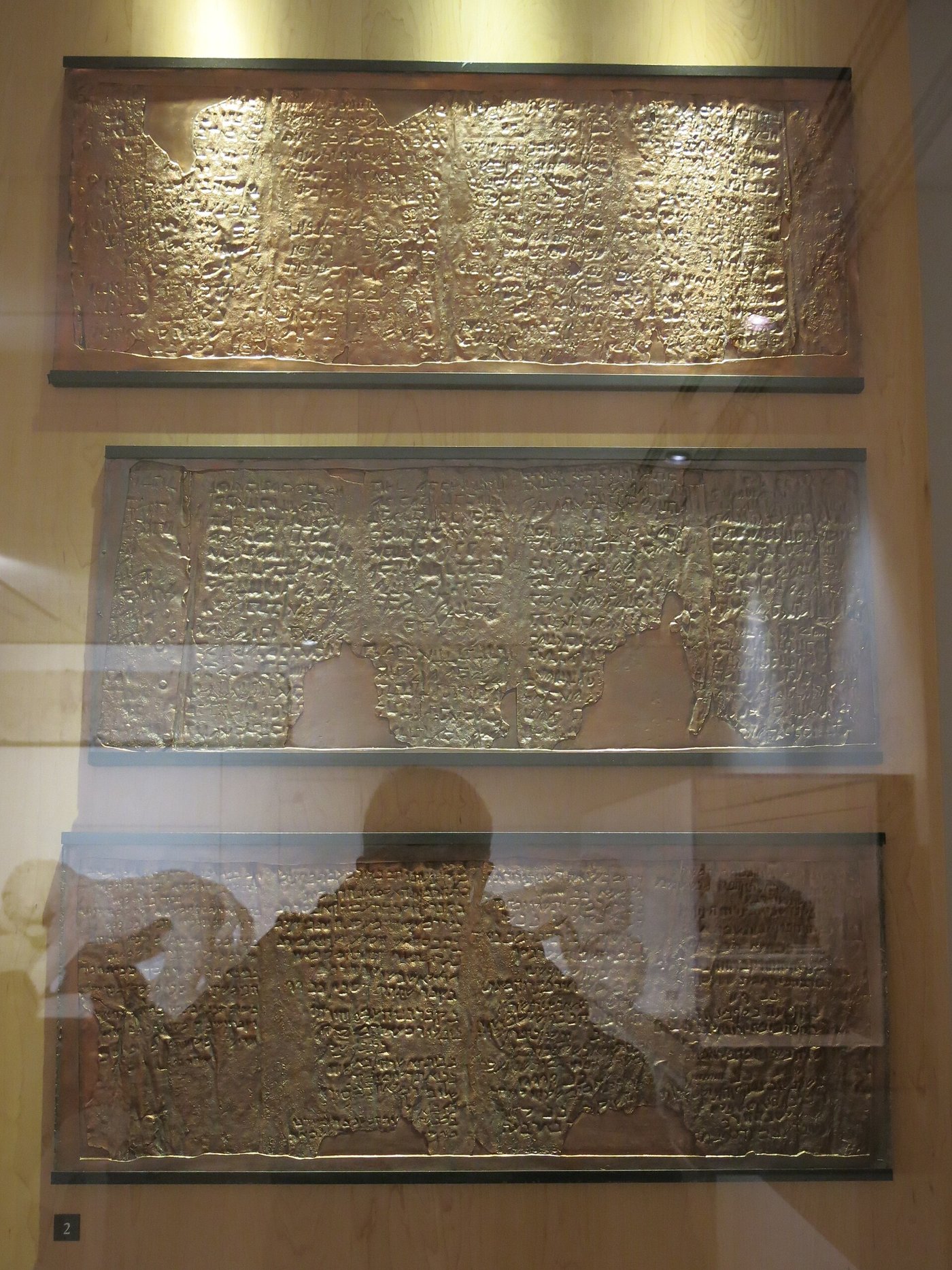
The trouble with using the scroll as a treasure map is that it was written for someone who already knew the landscape. Its authors did not draw pictures or give coordinates. They named places the way you would tell a neighbour where you left something: by the local landmark everybody recognised. "In the tomb of the third course of stones." "At the mouth of the spring belonging to the house of." "Under the eastern corner of the courtyard." These were perfectly clear directions in the first century. Two thousand years later the tombs have collapsed, the springs have shifted or dried, the houses are dust, and the courtyards are fields. The map survives; the country it describes is gone.
There is a further riddle woven into the text. Seven of the entries are followed by clusters of two or three Greek letters, dropped without explanation into an otherwise Hebrew document. No one has ever settled what they mean. Some scholars think they are a code, or the initials of the men who did the hiding, or cross-references to a second, fuller document that has never been found. Whatever they were, they were meant to help a reader who had more information than the scroll alone provides, a reader the writers evidently trusted to fill in the gaps. That reader is exactly who we are not.
Even the weights work against a modern searcher. The talent and the units of measure in the scroll cannot be pinned to a single fixed value across the ancient world, so the fortune is impossible to price with any confidence. Depending on how you read the figures, the totals swing from staggering to frankly unbelievable, and that uncertainty is itself a clue that scholars have pulled in opposite directions for decades.
The man who went digging
If any one person made the Copper Scroll famous, it was John Marco Allegro. He had pushed for it to be opened, he supervised the cutting in Manchester, and he was the first to publish a full popular translation, in 1960, ahead of the official scholarly edition, a breach of etiquette that annoyed the rest of the editorial team and set the tone for a career full of them. Allegro was convinced the treasure was real. To him the scroll was a real inventory of the wealth of the Jerusalem Temple, spirited away and buried in the years before the Romans sacked the city in the year 70.

He did not stop at believing. In 1962 Allegro organised an expedition and went looking, tramping the hills and wadis around the Dead Sea with the scroll's directions in hand, excavating at the spots he thought he had matched to the text. He dug at ruins, probed under likely staircases, opened promising ground. He found no chest of silver, no consecrated gold, nothing at all that the scroll had promised. The most determined treasure hunt the document ever inspired ended precisely where every later one has ended: empty-handed.
"The reader of the Copper Scroll is not being teased with fairy gold. He is being shown, in the driest possible language, where a great deal of very real treasure was put for safe keeping — by men who never came back to collect it."— John Marco Allegro, writing on the scroll he fought to open
Allegro's later years did his cause no favours. He drifted into ever more sensational theories about early religion and lost the confidence of most of his colleagues, and it became easy to wave away his views on the scroll along with the rest. But on this one point he was not obviously wrong, and serious scholars have kept his argument alive. The document really does read like a plain inventory. The awkward question is whose.
Real hoard or holy fiction
The scholar charged with the official edition, the French priest and specialist Józef Milik, reached the opposite conclusion from Allegro and reached it early. To Milik the scroll was folklore: a legend of buried treasure, a story of the kind that grows up around any lost golden age, written down in the form of a list but no more factual than a tale of pirate gold. Roland de Vaux, who led much of the Qumran excavation, leaned the same way. On this reading the caves held a community's sacred books and, tucked among them, a popular fantasy about the vanished riches of the Temple.
The popular picture is simple and irresistible: the Copper Scroll charts the treasure of the Jerusalem Temple, hidden from the Roman legions, and one day someone clever enough will decode it, dig in the right place, and pull the gold of the ancient world back into the light.
The object is authentic and its text is a real inventory in real Hebrew; that much is beyond dispute. Everything after that is contested. Scholars split three ways over whether the hoard was Temple wealth hidden before the year 70, funds from a later Jewish revolt, or a treasure that never existed outside the scribe's imagination. And the directions were written for readers who already knew the ground. Nothing the scroll lists has ever been recovered, and no one can yet prove it ever could be.
Between the two extremes sits a crowd of middle positions. Some argue the treasure was real but belonged to the Temple's ordinary revenues, hidden by priests as the war with Rome closed in. Others tie it to the Bar Kokhba revolt of the following century, making it a war chest rather than a religious hoard. A few detach it from Qumran altogether and suggest it was carried to the cave from elsewhere, a document that simply ended up filed among strangers' books. Each theory explains some features of the scroll and stumbles on others, which is why none of them has won.
Why the ground has stayed silent
Suppose, for a moment, that the treasure was real. There are still good reasons nothing has surfaced. If the metal was hidden from the Romans, the Romans (who were nothing if not thorough with conquered wealth) may well have found and melted most of it long ago. Buried silver that is dug up and reminted leaves no label behind; it simply becomes Roman coin. A hoard recovered in antiquity would look, to us, exactly like a hoard that was never there.
Then there is the politics of the search. The places the scroll seems to describe are scattered across land that is now divided between Israel, the West Bank and Jordan, some of it militarily sensitive, much of it archaeologically protected. You cannot simply arrive with a spade and start opening ancient ground; and the handful of modern hunters who have tried to match the scroll's clues to real sites have run into the same wall of vague directions and lost landmarks that stopped Allegro. The scroll gives you a place. It does not give you the place.
Seventy years of scholarship have not closed the case. Believers point to the scroll's flat, factual tone and ask why anyone would hammer a fairy tale into costly copper. Sceptics point to the wild totals, the folklore parallels and the complete absence of a single recovered coin. The honest answer is that the Copper Scroll is a real document making an extraordinary claim that we can neither verify nor dismiss, and that may be the most it will ever tell us.
What the scroll keeps to itself
The two green rolls now rest in the Jordan Museum in Amman, cut into strips and set behind glass, a long way from the cave where they waited out two thousand years. Copies and facsimiles have travelled the world, and the text has been transcribed, translated, digitised and pored over by more experts than any pirate map ever was. And still it holds its secret. We can read every word and reach none of the gold.
That is the strange gift of the thing. Most ancient objects tell us about people who are gone: how they worshipped, what they ate, how they died. The Copper Scroll does something rarer. It leans across two millennia and tells us, very precisely, where to go, and then, in the same breath, takes back every landmark we would need to get there. Somewhere in the directions is either the largest buried fortune ever recorded or a scribe's magnificent bluff, and the only people who could have told the difference put their answer into metal so it would outlive them, never guessing that outliving them was exactly what would make it impossible to read.
Read next: The Burning of Jerusalem: What the Charred Beams of 586 BCE Reveal and Inside the Voynich Manuscript: The Book No One Can Read.
Sources & further reading
- John Marco Allegro, The Treasure of the Copper Scroll (Routledge & Kegan Paul, 2nd edition, 1964) — the first popular translation and the case for a real hoard.
- Józef T. Milik, edition and commentary on 3Q15 in Les 'Petites Grottes' de Qumrân, Discoveries in the Judaean Desert III (Oxford, 1962) — the official edition, arguing for folklore.
- Al Wolters, The Copper Scroll: Overview, Text and Translation (Sheffield Academic Press, 1996) — a careful modern edition of the Hebrew.
- Judah K. Lefkovits, The Copper Scroll 3Q15: A Reevaluation (Brill, 2000) — a detailed re-reading of the locations and amounts.
- The Jordan Museum, Amman — display notes on the Copper Scroll and the Qumran finds.
Image credits (via Wikimedia Commons): the caves of Qumran — SuperJew (CC BY-SA 3.0); Copper Scroll strip at the Jordan Museum — Osama Shukir Muhammed Amin FRCP(Glasg) (CC BY-SA 4.0); facsimile of the unrolled scroll (Louvre) — Tangopaso (public domain); John Marco Allegro — Jack1956 (CC BY-SA 3.0); scroll jar with the Copper Scroll — Dale Gillard (CC BY 2.5); the Copper Scrolls on display in Amman (featured) — Osama Shukir Muhammed Amin FRCP(Glasg) (CC BY-SA 4.0).